Completed Buildings
Production, Energy & Logistics
Kalyon Karapınar 1.350 MWp SPP
Central Control Building
WAF Award
Bilgin Architectural Design Studio
Begüm YILMAZ BİLGİN | Founder
Caner BİLGİN | Founder

Journey of a Selected Structure
Kalyon Karapınar Central Control Building is a building realized through an architectural competition process. The conceptual proposal we first presented to the jury was then developed and constructed in its own context during the implementation phase. The WAF process meant presenting this journey to a second jury, this time in its realized form. It was a very instructive experience for us to be able to explain the same project through both idea and physical reality.
On Motivation and Expectation
Taking part in a platform like WAF undoubtedly requires a certain motivation. However, the goal of receiving an award did not get in the way of the process. The real value for us was to explain the project, to interact with architects from different geographies and to observe their productions. The award was of course gratifying, but it was not the main factor that made participation in the festival meaningful.
Observations on Category and Content
The Production, Energy & Logistics category covers a wide range of projects. From industrial buildings to agricultural structures and logistics centers, you encounter projects of different scales and functions. This diversity gave us the opportunity to see how architecture is differentiated not only by typology but also by context, employer, climate and cultural background.
Presentations and Interaction
Listening to projects from different geographies at the festival showed me how variable the concerns about architectural production can be. For example, the architectural approach of 5468796 Architecture, based in Canada, through re-functionalization and detailing was very inspiring for me.
Similarly, listening to the mutual presentations of projects such as Istanbul Modern and the Museum of Painting and Sculpture in the culture category allowed us to see different perspectives on the transformation of Istanbul at the same time.
WAF’s Contribution to Architecture Culture
WAF is not just a competition, but an event where architectural culture meets on a polyphonic platform. While the presentation format encourages architects to defend their projects, it also provides a very fast and intense information exchange. In addition to the project presentation, direct contact with the jury and receiving verbal criticism offers a process that enriches your thinking as an architect.
Space and Continental Perspective
While the fact that the event takes place in Singapore facilitates participation from the Asia-Pacific region, it can lead to limited participation from the Americas. In this respect, the fact that the next event will take place in Miami is especially valuable in terms of its potential to make more South American architecture visible. I think that productions from this continent often do not find enough space on the global platform.
On the Future of the Festival
Although WAF’s category system can sometimes seem limiting, it provides an important framework to describe the diversity of architectural production in different contexts. But the real power of the festival lies in sharing the stories of how the projects came to be. The winners are of course visible, but behind each presentation there are other layers that contribute to the culture of architecture. Highlighting these layers more will increase the festival’s value as a platform for architecture rather than a competition.
Completed Buildings
Production, Energy & Logistics
Kalyon Karapınar 1.350 MWp SPP
Central Control Building
WAF Award
Kalyon Karapinar Ges Central Control Structure…
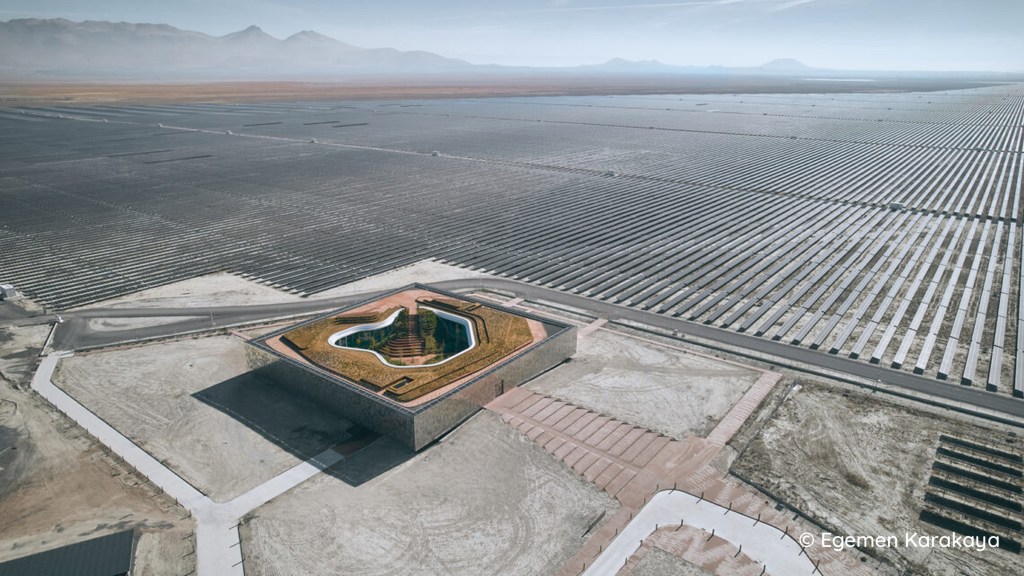
The project has a very beautiful story. When we started the project, when we first went there, it was completely arid land, not exactly sand, desert, technically called desert in the EIA reports. But of course the situation there is not the image of a desert as we know it. We have always explained that it shows signs of a desert climate. The main criteria for this are as follows; first of all, the temperature differences between day and night are very high, the humidity is very low, there is a temperature of about 45 degrees in summer and the soil in the region is unsuitable for agriculture. Even before starting the project, we took samples from the site and tested them in the laboratory, and we saw with our own eyes that they were not suitable for any kind of plantation. Therefore, this is actually the periphery of an old lake bed and it is predictable that it is unsuitable for agriculture with this drought. But I know that it was also used for pastoralism by the people of the region in the past. I don’t know how intensive pastoralism we are talking about. We are talking about a flat 20 km2 area where almost no grass grows. Drawing a project in such a region already requires great sensitivity. There is a 3-year process that we have spent very intensively, from the construction technique to the materials we have chosen. There is a process that we have designed very carefully at every stage and implemented on site. Impact of the Project on Ecology…
From the very beginning, we had this question in our minds; when so many solar panels come to this area, what will be the impact on the geography and ecology of this area? This is a critical question. Will putting this much glass surface increase the temperature of the region even more? It’s only been 1-1.5 years, and in 1.5 years we are starting to observe amazing things. First of all, we observe that the temperature of the surrounding area does not increase. The reason is that solar panels work on absorbing heat in principle, and they are bifacial panels, and they have the ability to convert the light reflected from the earth into electricity. We noticed that the panels, which are 1.5 meters above the ground, retain moisture over time, and because they retain moisture, the endemic grasses in the region rise again, and it has a very interesting appearance now, unfortunately we still haven’t taken a current photo of it. But underneath those panels, they are now at a level that we can call quite green. Of course, this can also pose a negative situation for the power plant. Those weeds need to be mowed somehow. Because these panels are mobile systems. When the grass reaches a certain height, it must be cut. Therefore, they have started a project that allows pasture under the panels in a controlled manner. This is a very interesting project. The grazing time of the animals is usually very early, at 5 or 6 in the morning. That’s exactly the time when the panels are not working and are in a fully horizontal position. During these hours the animals eat the grass under the panels. So there is a situation where pastoralism is practiced and the power plant actually gets rid of the grass and a win-win relationship is established. A very wonderful story developed spontaneously.
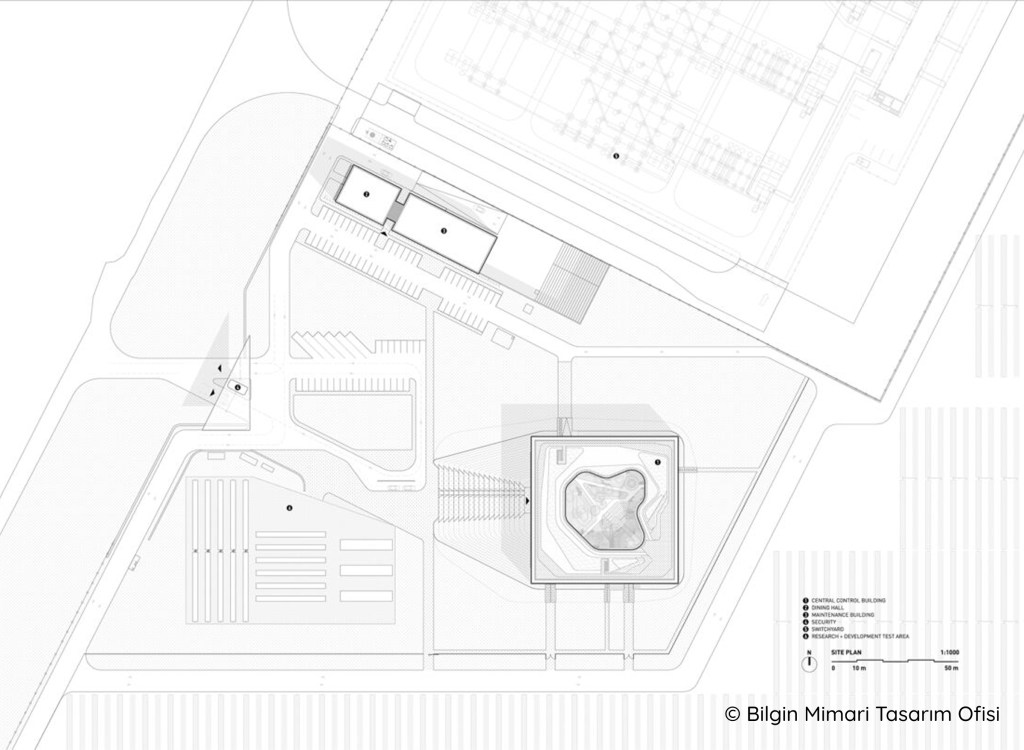
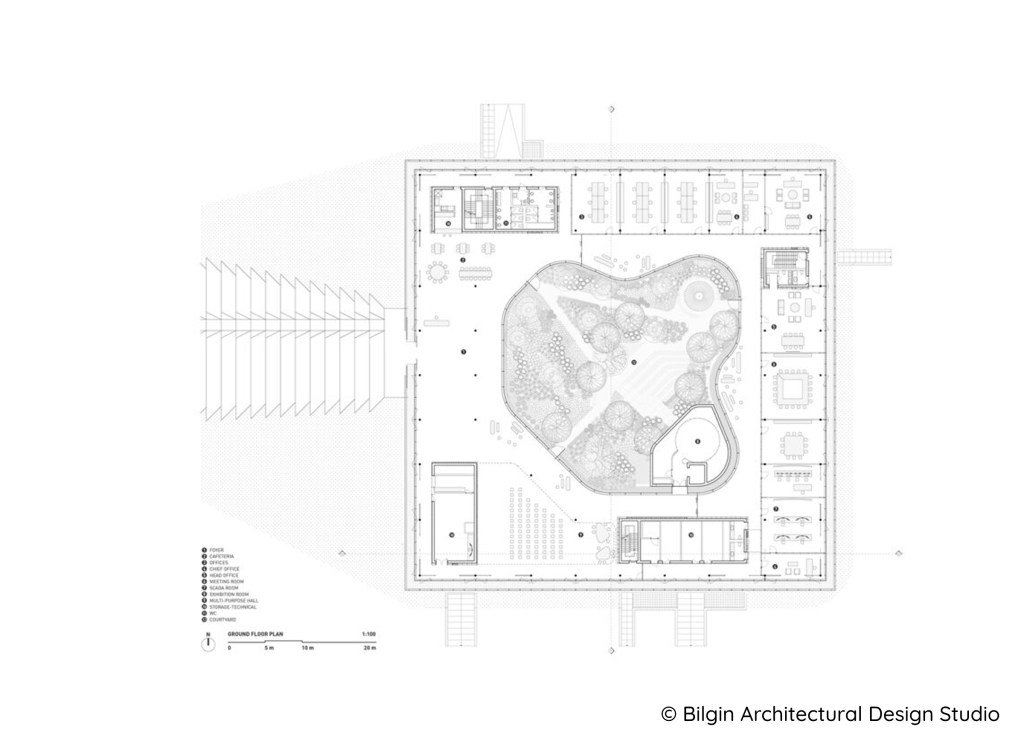

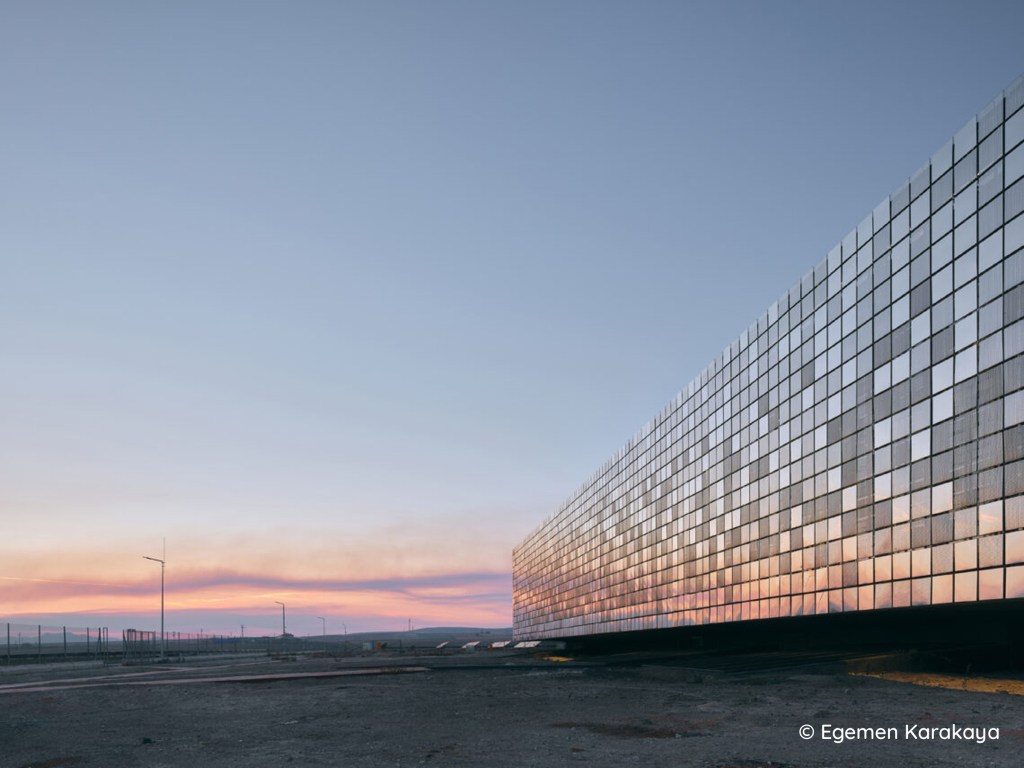
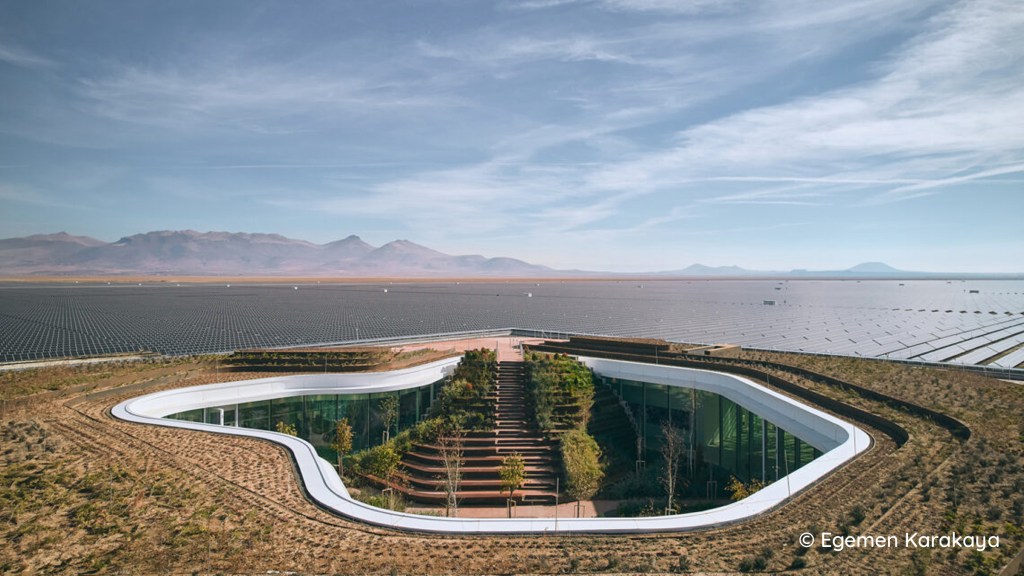
The scale of the work here is like a science fiction movie. 3.5 million panels, 1.5 meters high, repeating themselves over 20 km². These numbers don’t mean much when you imagine them, but when you go and see what it means, when you drive past it for 20 minutes without seeing anything else, you feel the scale and the magnitude of that production. The greatest happiness for us is that the building and its users continue their lives with great comfort within this ecosystem and this harsh geography. The building has undergone some tests in the past year.
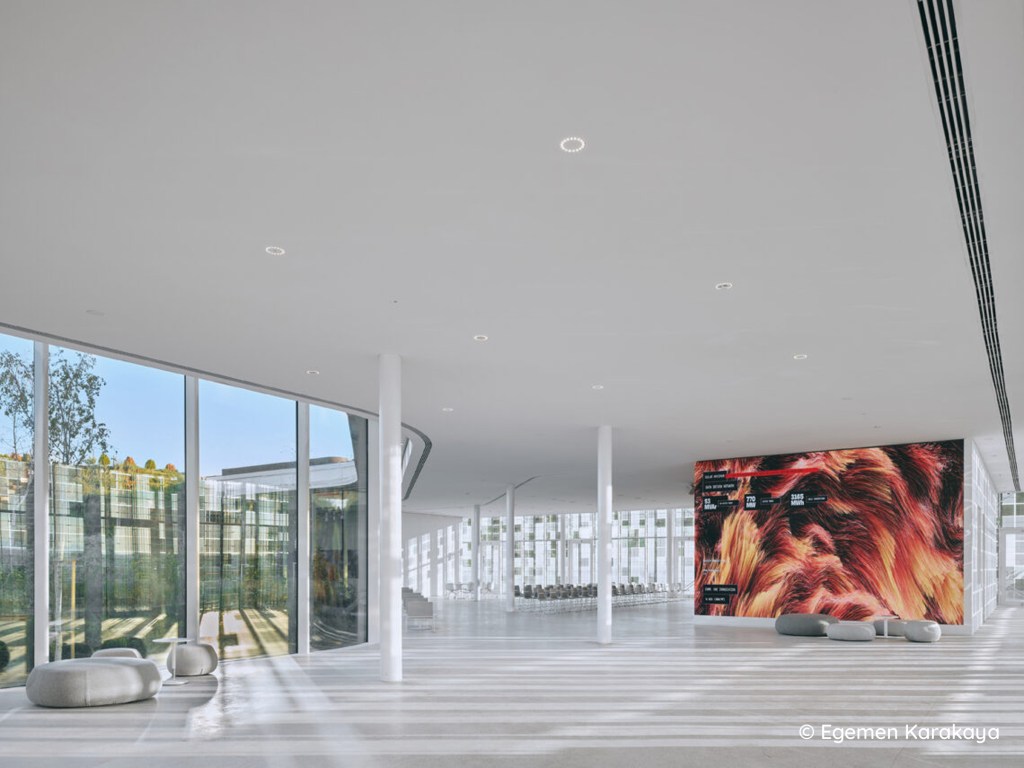
One of the important tests was this: The United Nations organized a panel hosted by Kalyon PV with their own organization and their own demands in this building. There was a group of about 400 people, and although the building was very small, the fact that such a group was hosted in that building without any problems created a point where we physically tested that the heating, cooling and other systems of the building were working properly. Apart from that, as far as we can see, the employees are able to continue their work in the building, which is active 24/7, in shifts, in that difficult geography without any problems. This is a great happiness for us. Because it is not easy to be able to work in a geography that we can call a desert, in a summer that reaches 45 degrees, and to be in a comfortable structure. It is very important for us to be able to do this in a passive and active sustainable way.
 Building That Meets Sustainability Requirements…
We were dreaming that we could connect the energy produced in the power plant here to our building with a cable and say, “Look how beautiful the building uses clean energy”. In fact, the building is a very important criterion for green certification programs. Therefore, we were imagining a situation where we could almost make a profit from this without doing anything. But of course, this was not the case. There is such a situation: It is an obligation to connect all the energy produced in the power plant to the state line. Even if it is your own building, even if it is a business structure, you do not meet the electricity of that building from that power plant. This is a legal obligation. I can say that this put us in a great challenge. It is not easy to emphasize and underline that what you are doing is sustainable in such a sustainable, green, energy-producing area. It is not very easy, especially in that region. It is a region where we cannot fully access local materials, where local craftsmanship is almost non-existent. It is very far from industry, the nearest big city Konya is 150 km away. It is quite challenging to make any kind of production due to the conditions. For example, there is one concrete batching plant working in the region. Whether or not you can get concrete to the site depends on the work capacity and mood of that plant on that day. I can say that we manage this process in an important way with the active and passive measures we take. We have tried to increase the efficiency of the building with many measures ranging from using each material where it should be and as much as it should be, to the most technological, smart electronic control systems required today. In that sense, I can say that we have actually achieved very good results.
 The Future of the Building…
After our project presentation at the WAF Super Jury session, Ian Ritchie asked, “What is this building going to be in the future, in about 30, 40, 50 years time, where will this building’s life span be? Can the building be used for another function?” It was a very good question. Actually, I can’t say that we were caught off guard because it was one of the issues that we have always thought deeply about. The solar panels used there have a lifespan of about 20-23 years. They all need to be renewed at the end of their lifespan. Their feasibility is already based on this period. If the power plant continues to exist in the future, it will continue to be used as a control center for as long as it exists. But just in case that power plant is somehow moved, not operated or abandoned, the building itself is a very flexible structure. The structural system, all our mortarless fabrications, dry walls and the flexibility of this and the lack of clear spatial boundaries give a more abstract and multi-purpose space. If we think roughly, this structure is a very sheltered shell, you can change it very quickly to whatever function you want to change it to. Because nothing is solid and solid, those walls can be easily removed, the office dividers between them can be easily removed, they can be divided into other types of offices, and if we consider that the needs of the operations of the office change without changing the function of the building, it is in a modulation that can adapt even to that. It is actually a system proposal. Not only the operational functions of this building, but also its public status is very exciting and valuable for us. International panels, trainings, special organizations on green energy, sustainable energy are organized here. We are very excited about the possibility of more of these organizations. If it becomes an institute or an R&D facility in the future, that alone would be a very exciting topic.
Location
Karapınar, Konya
Project Type
Office
Employer
Kalyon Holding
Status
Completed
Closed Area
2.700 m²