INSIDE | Health & Fitness
Doruk Nilüfer Hospital
ZOOM/TPU
Atilla KUZU | Co-Founder
being a finalist & motivation…
We have been to the finals 4 times, 2009, 2012, 2018 and 2024… But we have participated in WAF from the beginning. Being in the finals this year with a hospital in Bursa is enough success for us… We first participated in 2009 with the Acıbadem Maslak project (also a healthcare building). We reached the finals with the Acıbadem Maslak project, but the content of the competition was different there. Because in the category where the Maslak project made it to the finals, an Italian won first place with his Korean Showroom… Weighing a 200-300 square meter area and a 45,000 square meter hospital project in the same scale seemed wrong to us at the time. The next time, in 2012, we made it to the finals in two categories with Liv Hospital. One was in the Commercial Space category and the other was in the health structures category. We competed in two categories and made two presentations. The category was reserved for healthcare buildings. We had a disadvantage there because it was not an architectural work. There was an Australian group. They had signed a very beautiful project with an investment of about a billion dollars. But they were not selected either. If I remember correctly, they chose a hospital in Vietnam. They chose a project that they thought was suitable for the general, local design language of that country. In 2018, we were in the finals with Memorial Bahçelievler. We did not go to the presentation, Memorial’s architectural staff made the presentation.
In every project, we try to raise the bar one step higher and higher. Repeating ourselves is the biggest fear. At the point where we repeat ourselves, we start to get boring and the result no longer satisfies us… Therefore, the aim is to go a little further in every project, to differentiate…
From now on, we want to evolve in different directions, as a designer, the aim is not only to build healthcare buildings. Of course we don’t only build healthcare buildings. We design cultural heritage projects, museums, very few, not many, but factories, showrooms, hotels, offices. There are very few stores, we almost don’t design any stores lately. We mostly design health structures. Because we have made a serious difference in this field, I can say that the subject of healthcare buildings has now stuck to us.
We started designing the interiors of healthcare buildings intensively in 2004 with Acıbadems. In fact, our first healthcare building design was in 1997 with Sevgi Hospital. At that time, Hayati Tabanlıoğlu had passed away and Murat Tabanlıoğlu was continuing the architectural project. There was a building next to the Shopping Center that was intended to be a Health Museum. I think Sevgi Hospital had bought it. Thanks to our work on the Shopping Center side and the fact that the construction group knew us, the Sevgi Hospital job came to us. We drew the interior architectural project, finished it and delivered it. Sevgi Hospital closed down before they could move there. Acıbadem Group bought the building. Then they realized that the building had a ready-made interior architectural project and it was beautifully drawn. According to this project, they do the application without changing it at all. Then, when they need interior design again, I think in the early 2000s, they go back and look at that project, Zoom TPU is written in the legend. Then in 2004, if I remember correctly, they called us to build polyclinics in a hospital building that Ertem Ertunga had designed. Sevgi Hospital was our first experience in healthcare buildings, so our knowledge of healthcare buildings was very limited. In this respect, we can say that we started by working with Acıbadem Group and thus gained experience in this field.
In the past, there was no five-star hotel approach in healthcare buildings. This approach is a concept developed with our bad hospital experiences. We can say that those bad experiences caused us to change the perception of the interior space in these hospitals. Because space directly affects patient psychology and people coming to the hospital need to feel good. We are happy to be one of the pioneers of this approach.
In Europe, America, England, for example in Germany, the health system is very different. In Germany, the state is the main owner of this business. So I don’t know if there are private hospitals there or not. The design approach in this sense is mostly in countries like America or South Korea, China, maybe Japan. We went to the US with Acıbadem Group; we visited many hospitals in Detroit, Houston, Chicago. I can say that they are all ordinary, like our PPP projects, a little better than state hospitals. There are very few differentiating examples, or rather, there are not as many differentiating examples as in Turkey, as far as I have seen and examined. For example, in Germany there is a hospital for neurology and neurosurgery called the International Neuroscience Institute (INI), built by SIAT GmbH, which resembles the structure of brain cells.
Hospitals are usually ordinary places with no emotion in the interior design. When people from abroad see the hospitals here, they cannot believe what they see. Private health investments in Turkey have been highly encouraged by the state. Therefore, our employers have turned this business into a race. Thus, there has indeed been an improvement in private health structures.
As we saw at WAF, we are on the right track. We have not fallen behind in terms of line, in terms of architectural design language… We can produce works that are very up-to-date and express ourselves and they are accepted. That’s why we are happy.
highlights…
For architectural projects, the foundation of the work and the relationship of the most valued building with its environment. In interior architecture, approaches that can respond to known ecological and sustainable concepts. Of course, there should be no contradiction. Because transforming an existing, old, never-used building is very valuable, but rebuilding it loses 40% in terms of being a green building.
All we see there are new constructions, there are few transformations of the existing ones. For example, Durmuş’s [Dilekci Architecture] project was also very valuable. In A Design Problem event, he explained the project with a presentation under the name of doing without demolishing.
Singapore has become something like an experiential workspace… There is a lot of construction and at a time when so much construction, reconstruction, rebuilding, restoring the old and bringing it to life with a new function is very valuable, we should think about how meaningful it is to hold WAF in such an area. Everything is being redone, a lot of skyscrapers are being built. There are many examples in the Middle East.
Tomorrow or the day after tomorrow we may see Norman Foster’s or Jean Nouvel’s works in WAF, I don’t know if they will participate or not… But I think Foster had a few works if I remember correctly. I don’t see WAF as very consistent within itself. There can be different points of view, but they have to be consistent within themselves. This is a criterion.
preparation…
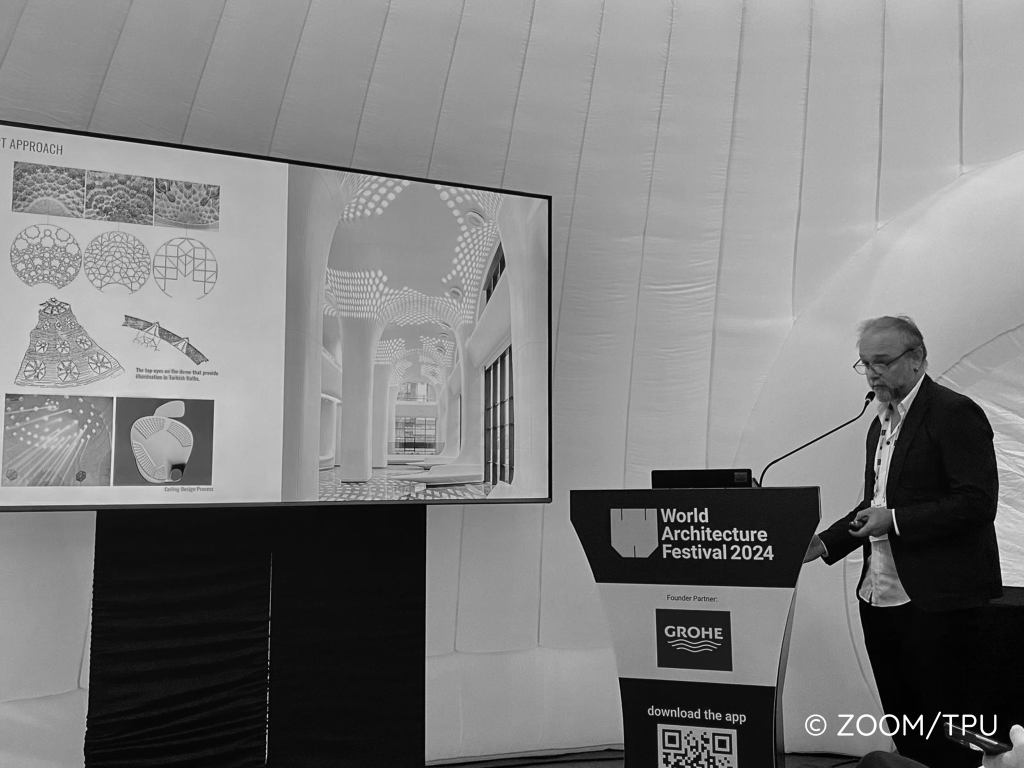
In terms of presentation, we didn’t prepare anything very different from the presentation we made to the client. Maybe there were some points we underlined a little more. When I presented this project at a Design Problem event, I talked about our understanding of an inner shell, our desire to experience the gripping effect of any natural formation in nature as a volume in an interior space. When we enter a cave, it is of course very difficult for everything to have integrity, to be able to somehow capture the perfection of nature… In our finalist project, in which we benefited from the natural resources of Bursa, the Byzantine, Seljuk heritage and the first capital of the Ottoman Empire, we tried to design based on the natural light source in a SPA, just as there is a natural light source in a hammam. We tried to explain something by talking a little bit about history and geography and underlining the main concept on which we based the project. Of course, it is debatable how much it corresponds.
WAF already has a format that we were told about, but as far as I saw, many people did not stick to that format. There were those who showed videos, there were those who showed animations. For example, we could have prepared a video, it would have been a much better narrative.
We showed a 7-minute video and finished it in 10 minutes. We could have done the same here, but we preferred to explain.
My suggestion for presentations is that they should not try to adapt to the format set by WAF. Because I have observed that most of the presentations do not adhere to the format. Therefore, they should express themselves in the way they can express themselves well, how they can express the project well.
remarkable projects & presentations…
When I look at the projects, there are some really creative works. Especially Emre Arolat’s award is very valuable… The Cemevi is perhaps one of the most creative and remarkable projects I have seen there…
The projects of all my friends from Turkey were very good and adequate. They were above a certain bar. When I look at it in terms of Turkey’s participation in WAF, it is very valuable. I think it will be even better from now on.
If there are new projects in this environment…
By the way, I should also give credit to Bilgin Architecture. Their project was very successful, very beautiful, one of the best projects I have ever seen. Konya Energy Control Center is one of the most distinguished and ideal projects there… It may have been left over from the question of sustainability. They also had to deal with a question like, “How ecological do you think they are here with stainless steel and glass?” I couldn’t make it to Caner’s [Bilgin] presentation, but he presented it here at A Design Problem, and I liked it very much. It’s a very qualified project, so I think it got its due by winning the award.
Both Emre Arolat Architecture and Bilgin Architecture were awarded for both projects.
about WAF…
There was something about WAF this year that disappointed me. Since 2009, it is actually a very prestigious competition, a platform where we really see, like, follow and admire a lot of works done by star architects, where tremendous works compete. We enter all of them, we listen to their presentations, but we know that WAF has a reputation for being the initiator of this business, so with that momentum, it has brought this prestigious competition here for 16 years more or less.
It is one of the most prestigious competitions in the world… But I don’t think they can position qualified juries to evaluate the projects of the participating architects. Because when we look at it, there are really very good projects. We know more or less the evaluation criteria of the jury members. Of course, we have witnessed many juries that evaluated the subject or the project very well, handled the criteria very well and directed the right questions, I can’t do them all justice…
How meaningful is it that it is held in Singapore? That so many competitors or hundreds of finalists travel all the way to Singapore to present their projects. Indeed, very serious sums are paid to participate in a festival. But for example, they even sell a coffee for a price. What I see now is that WAF is unfortunately not in a structure that can evaluate such a level, such intellectual projects, I’m talking about in general. Of course, there are many jury members, all of them are very precious, very valuable. When we watch the presentations of many projects, we witness that they question the projects with very right questions, from very right points. But for example, isn’t one of the most important criteria the carbon footprint?
While sustainability, ecology, harmony with the environment, being produced with materials from the geography where it is located, etc. are in question, the area where such a qualified competition that will give a positive message and direction to the world is being held is nothing more than a warehouse. Inside a warehouse, presentations are made in nylon tents [igloos]. Such ordinary seats and chairs where people with a design vision come and sit. For example, from my point of view, if the place where those project presentations are made is going to be a tent, shouldn’t they also be ecological or sustainable? Beyond a nylon tent, can’t cabins made of recycled materials be made? Can’t they be built or designed by someone and set up there? Very serious money is made. So when you look at it, what you get back is not much at all; you go in and out of those sessions. Even the presenter doesn’t have a glass of water in front of him. These are issues that can be solved very easily.
Even though the concept of projects competing against each other is a bit contradictory to us, we participate in order to understand our level, to understand how much our designs are acceptable or valuable to the whole world. To be accepted in the world, to make it to the finals, to receive an award, to be among so many valuable architects is also valuable for us. But in terms of organization, I can say that I find WAF extremely inadequate.
The fact that the presentations are only in English poses a challenge for many participants. Because those whose first language is not English cannot explain their project with their own emotions. I mean, including me. If I was presenting in Turkish, I would be able to explain it much better and it would be easy and very positive for such an organization to assign translators for each project, for each language. There was a Chinese person, for example, who used a translation app on his phone to understand the questions, and when he was asked a question, he would hold it, look at it, read it and answer, or try to answer. This should not happen. Simultaneous interpreting is not something that requires very advanced technology nowadays, it is something that can be adapted. Their insistence on participating in the project, in the process of participation, and their marketing is very organized, but they do not achieve the same success during the organization. Unfortunately, I found the WAF organization extremely inadequate, inconsistent within itself, and the jury members sloppy.
WAF 2025 & Miami…
We learned that the next competition will be held in Miami. Why America now? Imagine that I am going to submit a project, my visa to go to Miami has expired and they are giving me a date a year later for my visa.
It’s as if there is a group behind this that says let’s enjoy a little bit of warm climate, we are bored with the rainy climate of England… So let’s do the first one in Barcelona, then let’s do it in Singapore, then let’s do it in Miami…
WAF’s development & progress…
The positive side of WAF is the communication between the participating architects, interior architects and designers. Seeing and perceiving the projects presented there, attending the jury sessions, communicating with the presenters… Listening to the conferences, listening to influential names in the field of architecture, witnessing their presentations or seeing and analyzing architectural design approaches is the most valuable part.
All of these create the idea that I can build on what I have seen, listened and learned and do something else. It is very valuable in terms of triggering the excitement of design in people, the excitement of producing something new, that’s actually why I participated.
We were a finalist in the INSIDE | Health & Fitness category with Doruk Hospital [Bursa] in 2024 with our interior design that fits into the existing architecture. There were 4 projects in the same category. Two of them dealt with the subject together with its architecture, one of them was a design that settled into the existing structure as we did. At the end of the day, none of us got an award. This is the first time in 16 years of WAF history and I think it is extremely disrespectful. They call 4 finalists to choose one to compete in Singapore and none of the projects get an award. There is no category winner [winner, highly commended]. I think this is also against the competition procedure. In the end, it was not a result that the WAF committee approved of, but they respected it because it was the jury’s decision. The jury could have chosen someone, it didn’t matter if it wasn’t us.
Among the finalists were people from China and England. The jury gave reasons that they were not impressed by the project presentations. The issue here is not whether they were impressed by the presentations or not. It is disrespectful to the first jury that selected the 4 projects in the first place, to their choices, to the time and effort they spent… It was a great disrespect to the people who came all the way there, prepared that presentation, paid so much travel expenses, paid a certain price to participate in WAF. The evaluation criteria and perspectives were extremely wrong. I think the jury members should be chosen a little more carefully. For example, it is interesting that a hotel built in Cyprus was selected as a finalist in the health structure category [Health and Fitness] by the first selection committee. In a place built to provide SPA services to people coming to the hotel, people with physical ailments are not treated. SPA may be a ‘wellness’ area, but in my opinion it is not a healthcare structure.
Another project was a social responsibility project by a Singaporean architect. They designed a place like a hobby area in a space where the elderly and young children come together and spend time together. I couldn’t quite figure out what this has to do with health. I don’t know if it’s about healthy communication or something that would be good for the elderly. There was a Chinese team, they built a hospital. Actually, I think there were two projects that were going to be finalists for Health and Fitness. One was the Chinese hospital and one was our project. Our project had a physiotherapy area, there are underground water resources in Bursa. Using the thermal waters, treatment is provided with a number of thermal pools [hypnotherapy pools].
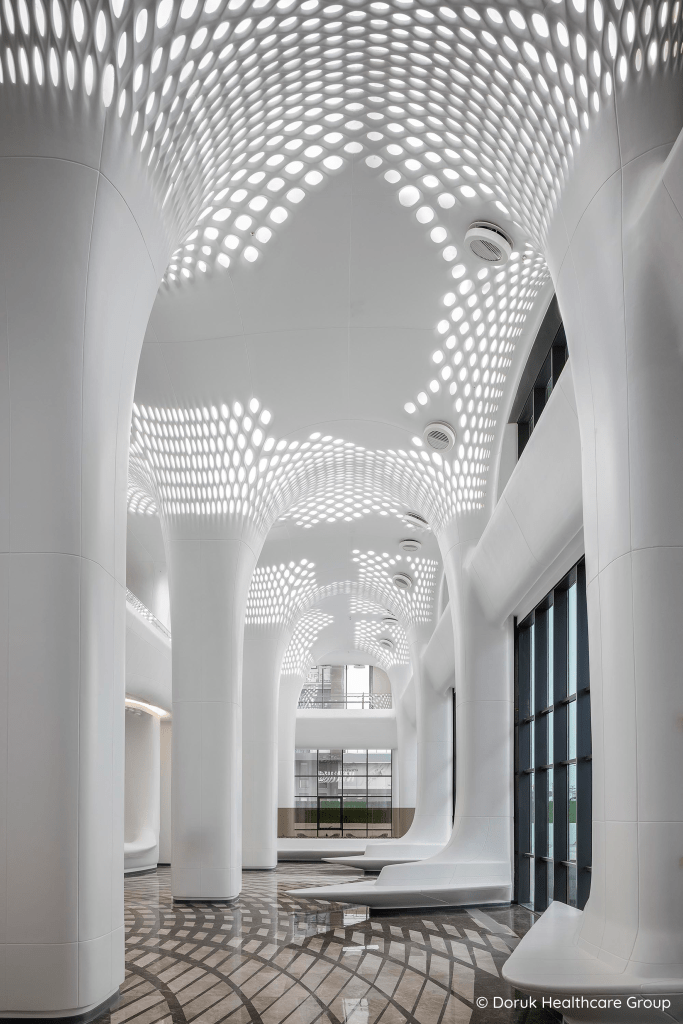
I also think there is a bit of prejudice, I think they didn’t choose anyone else because they would have to choose us. Because something like this happened in our project; the construction of the lobby required a lot of molds and labor. So maybe it was thought that there was no need for so much effort ecologically. In the end, we are creating an interior architecture, an inner shell, which we explained very clearly in the presentation. Where we came from, how we got to this point… The jury asked if we covered the columns. Yes, we covered the columns, because this is our design language. We also didn’t want columns with pointed four corners in a hospital building, we wanted to create a soft texture that wouldn’t damage people, that they wouldn’t be hit and damaged when passing by. We tried to reflect the texture created by the glass windows that receive light from above, which we call the elephant’s eye in Turkish baths. Since we didn’t have the chance to let in natural light, we achieved this with led lighting. With this texture, there is also a reference to the connective tissue that forms the internal structure of the human being. I think the jury’s questions and the way they handled the event were wrong. While there are countless projects where much more has been spent unnecessarily, if we have scored an ecological goal, it is very wrong. Carbon footprint, too much mold, too much energy…I don’t think interior design projects can be looked at that way. The positive effects on human psychology of creating spaces where people who come there for treatment will feel better cannot be denied.
In general, I don’t see WAF very different from 2012 [in terms of approach]. Now we see that some things like artificial intelligence are also included in the presentations. As a product of the last 2-3 years, we came across some of these in the presentations. But as I said, it’s not very different from 2012… When we look at it in terms of design approach, we should have seen an increased added value after the passing years.
INSIDE | Health & Fitness
Doruk Nilüfer Hospital
 Doruk Health Group is a well-established organization operating in the health sector in Bursa since 1998. It is not only a local healthcare institution, but also aims to combine its vision of growth with the fields of architecture and design. In 2018, a collaboration with Prof. Dr. Zeynep Kahveci was initiated to realize these goals.
Detailed processes such as planning stages, space layouts and circulations carried out in line with the project briefs were realized together with Prof. Dr. Zeynep Kahveci. Following the planning phase, the design process began, with the lobby area in particular being of great architectural significance.
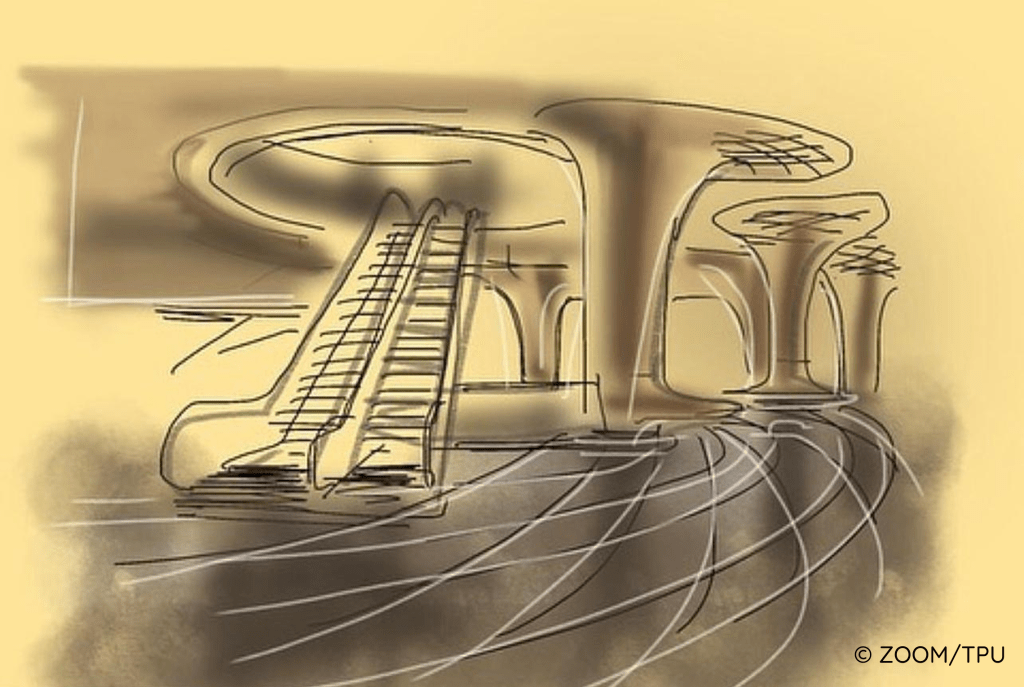
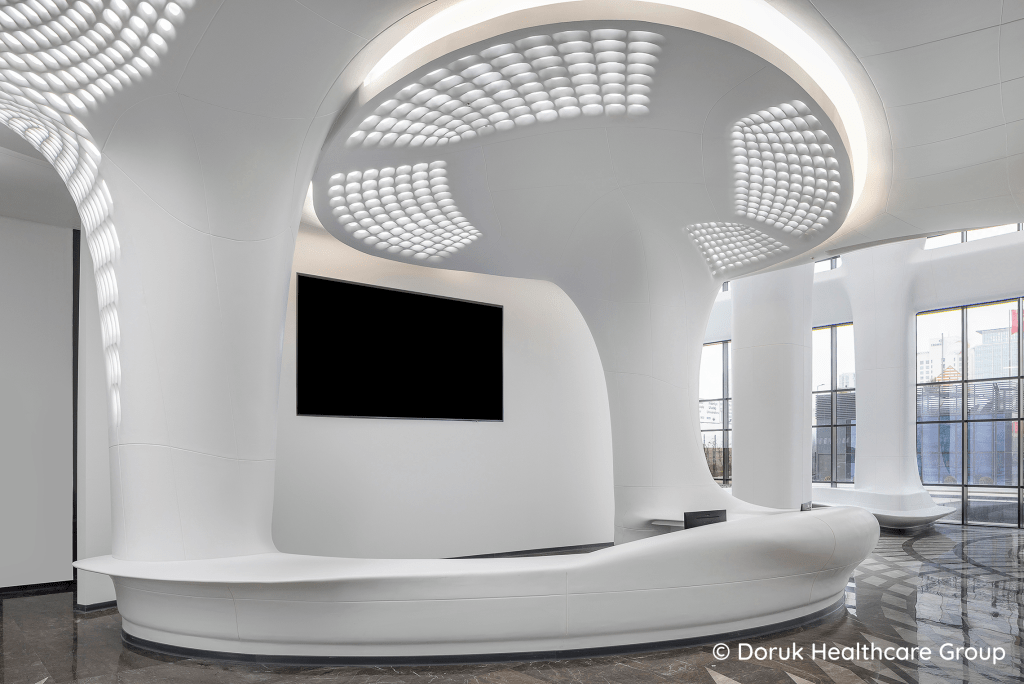
The lobby was designed as an area that attracts attention with its structural richness. The visual communication potential of the circulation area offered a wide field of creativity to the design. The columns of the lobby, extending from the ground floor to the mezzanine floor, are integrated into the building as a strong structural element. In addition, the gallery space starting from the ground floor provides access to the stairs leading down to the basement floors, which increases the integrity of the space and visual communication.
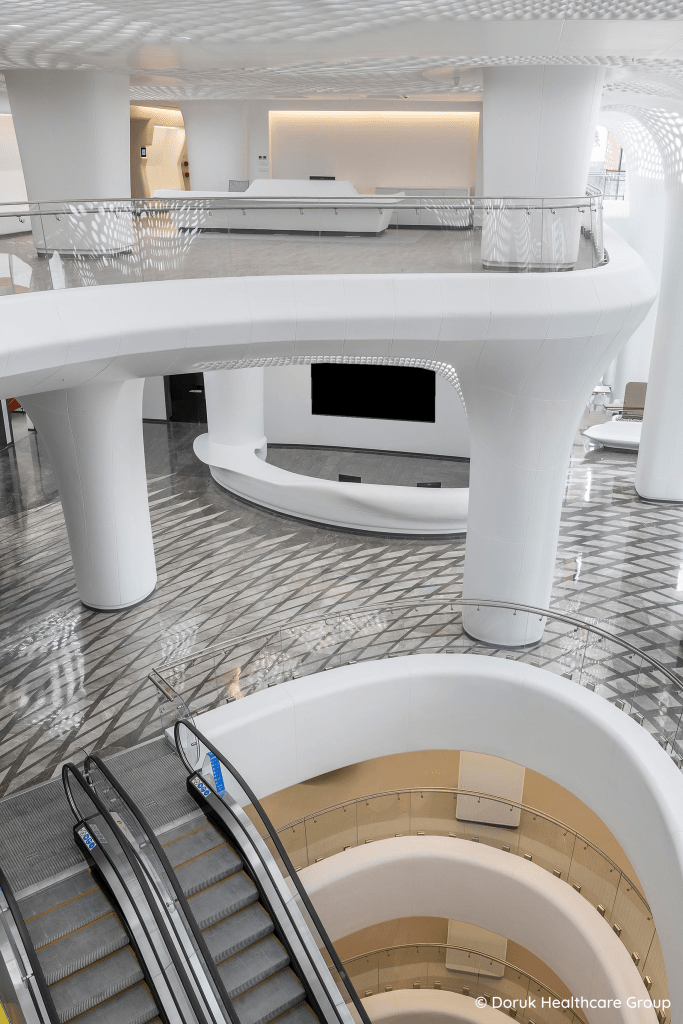
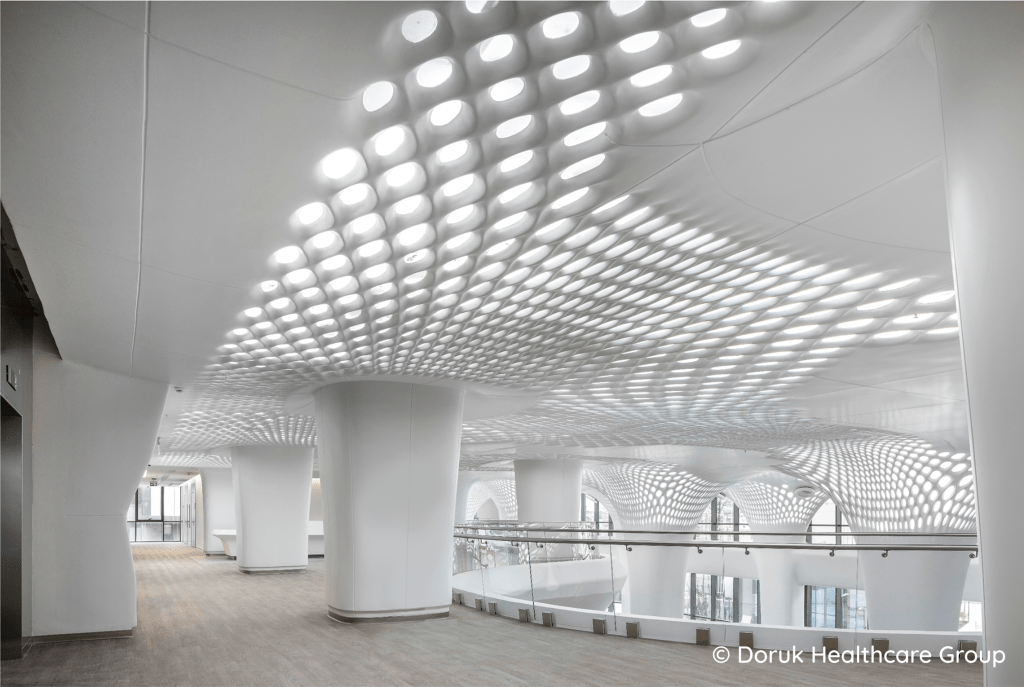
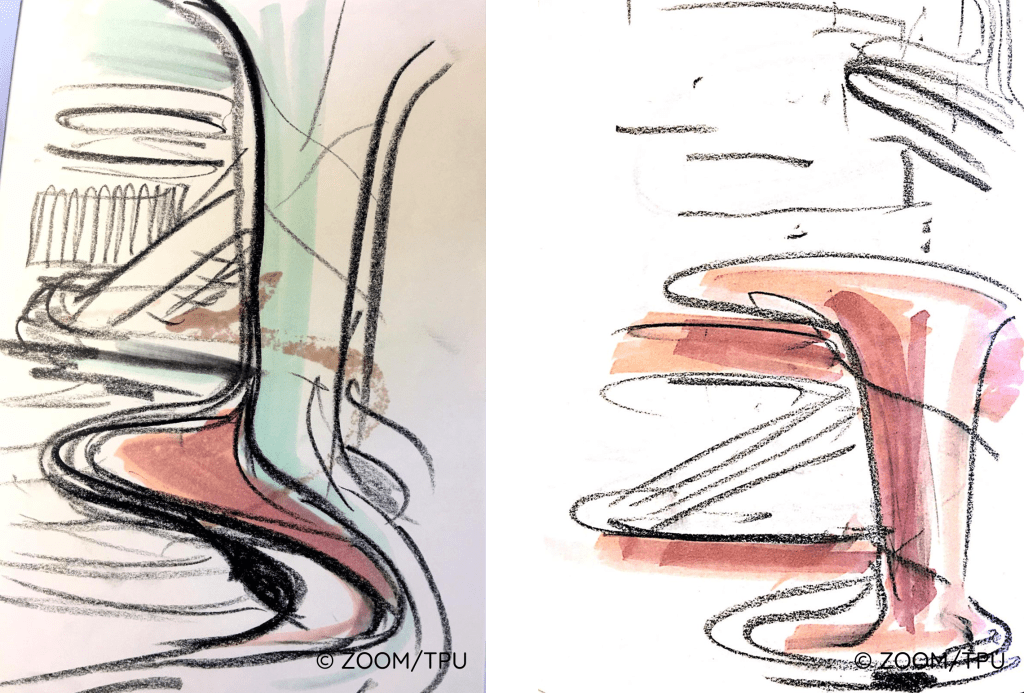
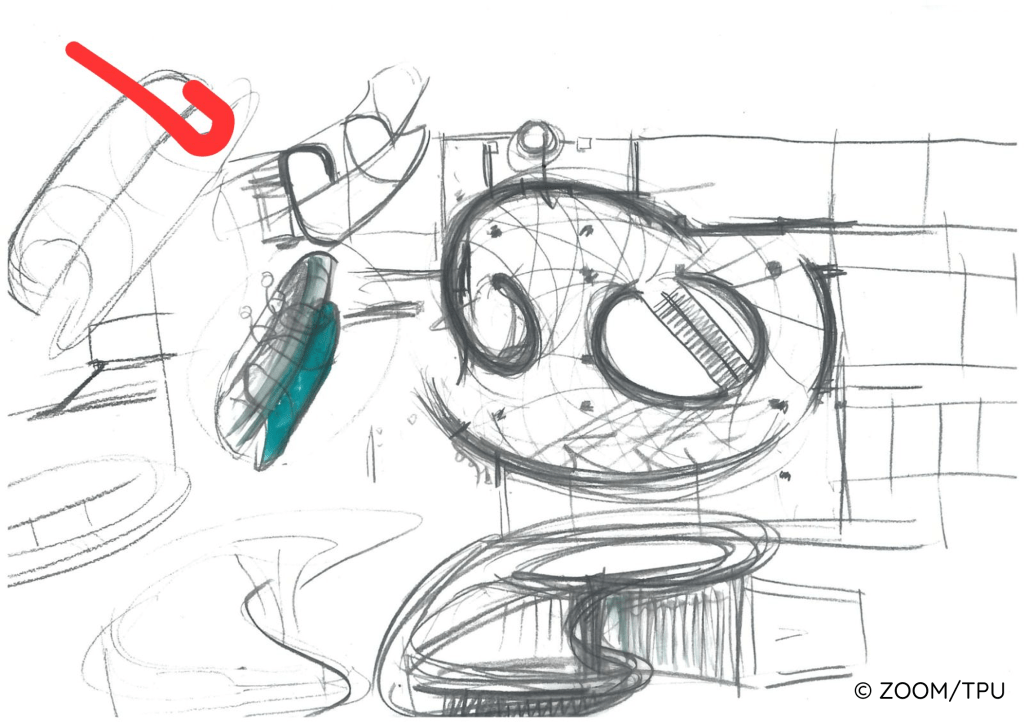
During the design process, the structural structures, seating elements, benches and lighting systems in the interior were designed in a parametric flow. Fluid surfaces define the main elements of the design by creating a shell that completely envelops the space. The interior is located in a unique parametric flow with lighting surfaces created with unrepeated panels made of precast material. The marble floor on the lobby is designed in the form of a vortex that grows and shrinks algorithmically. The hydrotherapy pools for men and women are analyzed with similar design principles. In the waiting areas, the nature effect is maximized with interior gardens. Seating elements have a design that integrates with the space and a holistic approach is adopted throughout the hospital.


Polyclinics and patient rooms are designed to maximize the use of daylight. Lighting designsare considered as a part of the structure and a holistic approach is adopted instead of implantelements. In all counter solutions, soft and fluid forms are preferred, harmonizing with thegeneral concept and adopting a human-oriented design approach.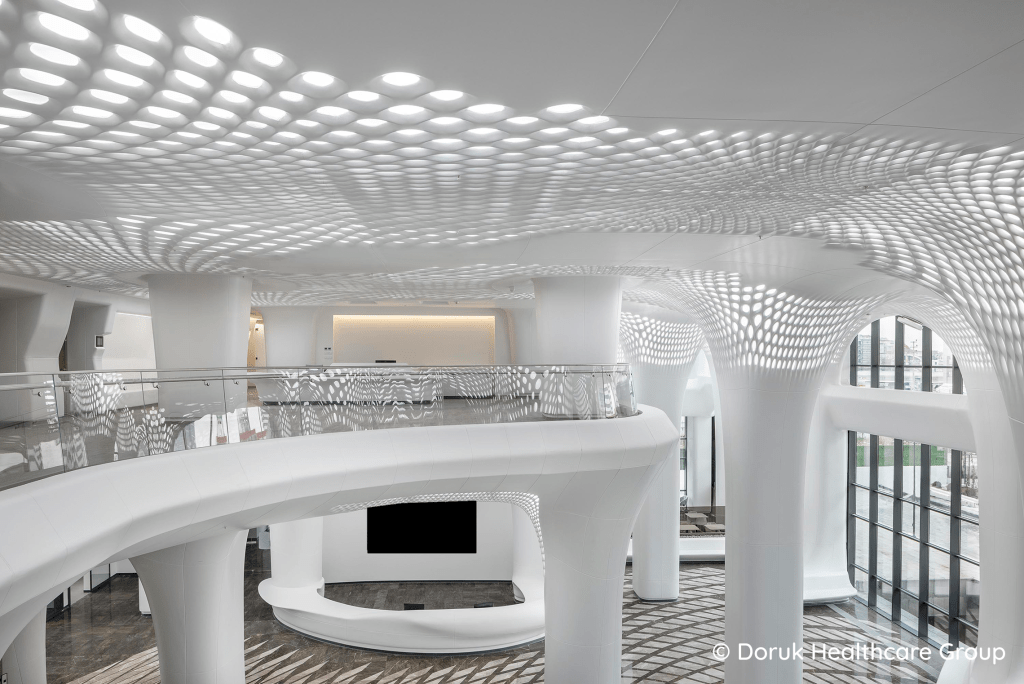
Project Name
Private Doruk Hospital
Project Location
Bursa
Project Type
Interior Architecture Concept Application Project
Partners
Atilla Kuzu & Levent Çırpıcı
Design Coordinator
Yunus Emre Kara
Project Coordinator
Özge Berberoğlu Kurbak
Interior Design
ZOOM / TPU