GAD | Global Architecture Development
Gökhan AVCIOĞLU | Founder
overall WAF experience…
I have been thinking for a long time about how we can make different contributions to WAF. Because WAF stands out as a competition with the most carefully prepared preliminaries, prestigious awards and prestigious feedbacks among architectural competitions. Why do I say this? Because many competitions have started to turn into purchasable awards that are given to you with your contributions or different supports.
When it comes to awards, there are other problems that also apply to WAF:
1 | Jury evaluation without seeing the buildings, without going inside the buildings or, if it is a site organization, without knowing anything about the site. Could there be an approach where there is a little bit more of a phasing effect, as in some awards? For example, in the Aga Khan awards, it is important for a technical rapporteur to go and at least see and report on behalf of the jury in order to reveal other values beyond the application. But of course, the Aga Khan award is given every 3 years. WAF is a group that aims to do this every year. So how will it happen? Perhaps the fact that there are so many applications and that such an organization takes place in various cities, especially in London, which is the headquarters of the WAF organizer, outside the UK, of course involves other extra costs. In order to meet these, there needs to be a large number of participants. Sometimes we even encounter a situation like this; a deadline is given. We meet that deadline. Then there is an intention to collect a demand again with more or even a discount. These are the elements that need to be considered outside of the general domain in terms of WAF.
2 | It is only open to architects and people around architects. It should definitely be in a position to reach a wider audience. This could also be in line with the purpose of WAF, for example, there is no one even from the official authorities in the cities we visit. However, why are we going to Singapore, Barcelona or any other city? We will go to Miami in 2025. If the real estate sector, which includes architecture, or the authorities are not interested in this issue, if it only involves the architect saying something to the architect, then it is a big deal.
suggestions…
How can WAF reach a wider audience? I don’t think WAF uses architecture in WAF enough. The architectural community and the real estate sector that architects are connected to, the authorities are a very large family, and there are also material companies and manufacturers. We don’t know which jury selected the finalist projects or buildings and what was done with them. That is also a mystery… It is as if Architectural Review or WAF selects them according to their own policy, then we are trying to select the selected, which is a bit incomplete… What am I going to defend? I need to see the others and I need to see all the applications so that I can make a correct evaluation. We are only jurying the finalists there. This is also a deficiency. There is a jury only in the future section. They already select directly there. Sometimes there is no re-selection for the future.
There is also a separate order and many categories of special awards within the selected projects. The first two days are really intense, breathless. And it was a lot of fun at first. But right now, there is a lot of strangeness in the way of expression, in the way the projects are defended there at the same time. In other words, it’s a bit like a blind fight. There is also a need for other effects such as examining them again afterwards, resulting in a report, resulting in a book. Why were they chosen? What happened? I would suggest a digital platform for WAF. Not just with little teasers like this, but a serious YouTube channel… It deserves it. Because every year there is a very good inventory of what is going on in the world.
Another issue, we talk about three elements in architecture; the creative, innovative and business side of a business… There are more issues related to the creative side, we see a lack of innovation, the sector [real estate, construction] that architecture is already in has a low level of creativity. In other words, it has a bit of a backward and regressive side, it comes from behind. However, there should be another section, one of them; especially now with the use of artificial intelligence, for the software and hardware used in the architecture sector. The innovative side is not inviting, WAF will claim that it exists, but… Who are the creators of the software we use, who did what? I wrote about it in my book Less or More, I continue to write and publish. Most architects do not know the groups that create the software of the programs they use and why they do it. Who was the creative group inside Autodesk? Who was the first to launch the web layout? Who were the main players, the first founders of artificial intelligence? Now that he received the Nobel Prize, maybe those names are known, but other than that, who were the developers of Adobe? I think these also make a very serious contribution to architecture. When did 3D printers start? What point have we reached today? We are going to build buildings with 3D printers now, the innovative part of them needs to be supported. Otherwise, an architecture that only stays in the creative part and only deals with the decorative, cosmetic side of the business. There should be a department called product design. Because everything we use in our buildings, from door handles to door hinges, is also a product design.
There is an expensive participation fee, and this is being considered to eliminate it a bit. But there are such groups [there are even in Turkey] for the same project to compete in 6-7 different categories in different lanes, maybe competent offices can allocate money for this, but for young people, there should be a 50% discount, maybe 70% discount for those under a certain age. Because we already know that in many countries the Chambers of Architects have age restrictions in order to be able to afford project experience. For those under 40, there is a situation where more experimental projects, more public space, are selected directly by the authorities to contribute. So that there is a homogeneous distribution. So why are we making these criticisms? So that we have a better WAF, an institution that we all benefit from globally. Maybe what we say may not be realized immediately, but it can happen step by step. In a more digitalized world, I think the use of artificial intelligence in the evaluation of groups will gradually come to the fore. That’s like asking for the evaluation criteria to be defined in a questionnaire when applying for a project…
Feedback should also be given to projects that are not finalists. A high contribution is paid, everyone has a right. I’m not talking about a series of awards that have become completely commercialized, I’m talking about a group like WAF, which has a certain definition and is almost one of the most elite.
assessment…
The purpose here is not so much the prize, of course; it is important to have participated and to make inferences for the culture of architecture, in other words for our global culture. One attends, receives an award, becomes a jury member, and then we spend a few nice, enjoyable days there and then it is forgotten. WAF is really one of the institutions that can do this best, I believe that. Therefore, it is important for all of us that this is continuous.
It is important not how many groups participate, but a situation where quality is at the forefront, not quantity. And that is that it is important to have an advisor, a group to advise. In other words, in which category does this project find itself better? Now, some projects may have the capacity to be in several categories at the same time due to their situation. There is another situation; it also imposes a time constraint for unbuilt projects. After 2023, for example… An unbuilt building always has a chance to be built. Why put such a time limit? I still have projects that have been going on for 30 years. Unbuilt, after they are not opened to the public, they can all be in the category of unbuilt or ongoing. So these category distinctions need to be addressed at several points. This issue creates a valid thinking space all over the world. Sometimes we have difficulties in some jury sessions. Our group was on Rural/Coastal [single-family housing]. We were lucky that the project we chose was in Singapore, the city we were in. There were even landlords who commissioned the project. They had to defend the project together. The next day we went and visited the building, we saw the building with our own eyes and we were satisfied with our choice. I can easily say this because I experienced this pleasure for the first time. We chose and we made sure of our choice by visiting. I wish we could have such a chance for every project. At the very least, let’s have a final final and see the two, three projects we have chosen… Or let the jury members choose and see one of the projects they want. These are all possible…
In the end, it comes down to this. The project needs to convince the jury. What are the tools it uses to convince? Good photography, a good presentation technique, and thirdly good graphic design, videos, images. As a contestant, there were times when I contradicted the jury. For example, in one of them, there was a scheme that we completely changed in the course of the project, that is, there was a scheme that we turned inside out. The jury did not understand this. How did you change this? Did this request come from you or the client? Why did you do such a thing? They questioned it a lot. However, sometimes there are differences between approaches in different countries. Sometimes you can move a little more freely in free space, in places where there are no strict urban policies, or in secondary cities, in open spaces, in other orders. Since the jury was mostly of European origin, they couldn’t believe how freely we were able to do this. For example, our One & Ortaköy project never received an award. I think it was a very important project, and rather than receiving an award, we could never share it there. Because we couldn’t match it. It was a high-rise building. We turned it into a low building, but we said that we want to develop our lost zoning rights in our own special plan. We said let us do this, and we made such a bargain with the municipality. This is not common, I think this alone was an interesting thing. For such examples that are worth sharing, we would actually like to make presentations outside of the competition. So there should be such a section. It doesn’t matter to compete, I may have missed the deadline, it may not fit into any category, but to share it, you are already charging me money to enter the competition, charge me money again, charge me a fee, and I will present my project there accordingly. Anyone can come and listen.
Historians I know say that it takes a quarter of a century for a building to be really established, accepted, for the architect to prove his claims. How will this happen now? We are evaluating fresh, hot off the presses buildings. We see that many of them do not fulfill their purpose later on. We see that they don’t bring the desired approach, or that there are deceptive elements in the photographs, but when we go and see it, it’s actually not such an effective building, it doesn’t blend in with its surroundings – there may be an intention not to blend in – on the contrary, it creates a serious problem. For example, Corbusier buildings in Shandigar can never compete in WAF. Because when you go and take photographs, you see very different things, but nothing is lost from the quality of the building, or the Louis Kahn settlement in Ahmedabad, when you go there, you have a hard time taking photographs. There are a lot of signs, something here, something there, but in the end the building doesn’t lose its value. Now I understand the purpose here, very iconic buildings don’t need such an award anyway, but for these, in order to draw attention to those who come there, there should be exhibitions or presentations of such buildings that WAF has selected, both retrospective and prospective. Our friend Rene from Singapore had a very nice exhibition. He exhibited all of Corbusier’s models. So it is important to have such contributions. It’s not just to come and exhibit their products, we need to ensure that these product design or production companies take the lead in such matters. They organize dinners and cocktails in their own kind, in a selected area, where only the guests invited by them can come. It should be open to everyone. Or such fair-type stands are not good either. As GAD Foundation, we have participated a few times, we have always prioritized design, design should be involved. We participated with Koleksiyon, exhibiting the Oblivion product, and once we participated with a waffle system that is now in our office. Such different stand layouts and exhibitions are necessary, they should be encouraged, I don’t think even the space fee should be taken from those who contribute to such a contribution. There should be such support for other institutions as well.
about WAF…
The format of WAF is Northern Europe, including the UK, Germany, France, Scandinavian countries, Lithuania and the whole band. It has a minimalist, unspectacular or spectacular format that makes a new contribution to the city, but does not stand out too much, where the effects of the human factor are minimized, explained with photographs and graphics, and organized from a more materialist fetishist point of view. We don’t even see their intensive use in the photographs. It is an element of the black and white, materialist fetishist, minimalist photography that Ezra Stoller started. Now, the human factor is much more important in the countries in the south, Africa and Asia. In fact, when Asia is involved, we see that the scales get bigger and the programs intensify. Because there are a lot of people. There is an Asian influence that started with Singapore [that’s why Singapore was visited]. Of course it doesn’t fit that format. There is a huge difference in understanding, a difference in approach between the design of a house for a family of three from Finland, on the forest or rocks, on the fjords, on the weekend, on the fjords, to make an observation, and the design of a park or a piece of city in the middle of Beijing, in the middle of a city with heavy traffic and 8 million people going in and out every day. Therefore, it is very difficult to perceive and understand all this in an exhibition setting, in a three-day competition setting. It’s almost as if WAF is based on a brief initial emphasis on yes, these are there, what the architect did, what the building is. That’s why I’m saying that regional differences, now something in Africa is more about content and humanization, serving people. Now, we are not looking for an architectural approach, quality or an innovative approach when we evaluate them. But there are such projects whose claim is about breathing new life into the city, about infusing the city with something new rather than joining it. Now there is a difference between the two. Therefore, in order to understand what we are doing in archaeological sites and semi-historical sites, which we encounter most often in Turkey, our language of expression there has to be like that of Northern Europe in order to be understood. Whereas in Turkey I work with official institutions to get something like this done, I push the boundaries and then something else happens. The jury cannot understand the guerrilla behavior here, they may not. It is difficult for them to understand why we make it look like that and do it differently, why we are constantly making improvements during a project under the renovation project. We also sometimes find it difficult to explain this kind of guerrilla behavior that belongs to this land. For example, our fish market project. One municipality has to deceive another municipality, they have to hide it from them. Or when we are doing something there, we act together with the fishermen there and maybe we don’t even go through a license and occupancy phase, we do it in the status of a temporary structure. Now where am I going to publish this project? There are interesting situations in such projects, I’m not talking about something very extreme.
For example, I attach great importance to the contributions coming from Iran recently. There is a very serious architectural development in Iran. But they seem to be coming to get results. That is, they want to get an award, they want to leave with that award. For example, there are such structures, which we also saw in our Rural/Coaster category, we see a structure that is high enough to be outside the city but within the city and moves with geometric systems. There may be a building that is lower and can have a different expression, in harmony with nature. But they rightly focus more on the movements of the facade and the materials they use on the facade. These are valid within the city, but there are much different values outside the city. But I see that Iranians get upset when they don’t receive awards. Because they have always been here and they are ambitious in their projects, they want to receive awards, I see that. Those who go from Turkey also have this ambition for awards. If they don’t get an award, they get upset, they don’t participate again. Yes, it’s expensive, but it’s not necessarily about getting an award. Sometimes I even think that the fact that some projects don’t receive an award is an important PR material for the promotion and publicity of that project in the future. For example, I’ve never received an Aga Khan award, I’ve entered a couple of times, because the Aga Khan system and my approach are not compatible. For example, I talked to Zaha Hadid about it, she said, “Forget it, it’s better not to get it. Zaha received an award at the Aga Khan after she passed away. Zaha’s projects never fit the Aga Khan system either. She is proposing a completely different system at the Aga Khan. Now, for example, my Esma Sultan project was entered, my Toilet project was entered, and they were shortlisted at the last minute. I was wondering how they would choose the restroom. Or maybe Esma Sultan, but Divan Kurçeşme also fell through the cracks. Because we don’t fit the definitions of the Aga Khan. It may or may not fit. If it fits, fine, but if it doesn’t, I will use it. Therefore, just getting an award is not a measure, sometimes falling offside, being left out, which is how many approaches, for example the impressionists, emerged. In France, those who didn’t receive an award had a separate exhibition and that’s how we got to know most of them. Because the French Academy at the time did not select it, because it did not fit the system, a phenomenon we all know as Impressionism emerged thanks to that exhibition. Therefore, whether the jury chooses it or not, whether it gets an award there or not, if you want to get an award or if you want to promote your project and architecture, you can write much different manifestos. We see that in countries in Asia, Africa and especially in many places like Turkey, which is also a part of the Middle East, the ambition to get an award has become a very strong situation. They are resentful when they don’t get one, and happy when they do. Of course, being happy should not only be focused on getting awards.
being a jury member… being a finalist…
It is valuable to be a finalist, to have that experience, to get the jury’s feedback and to understand what is actually going on in the world. You are actually buying an experience, a projection of the future, insight and feedback.
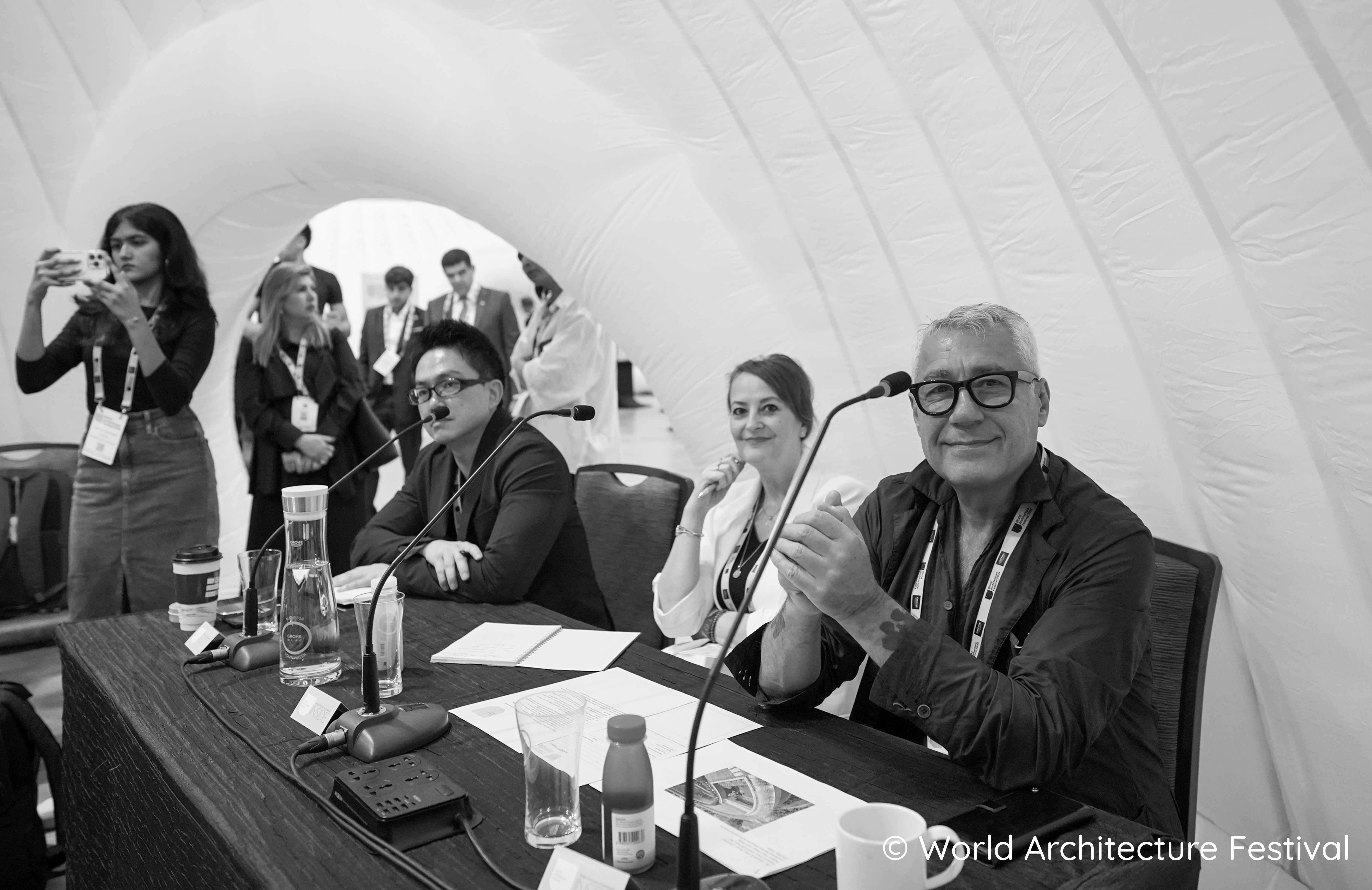
As a jury, of course, I want to experience and contribute to some things. I am a jury in 4-5 competitions every year. Recently we were again a jury for a group. We compete in some projects with the friends on the jury, sometimes they are the jury in some competitions, sometimes we are the jury. So this is a multidirectional interaction. Does it create a contradiction to be a jury and a finalist at the same time? Yes, of course, it definitely creates an effect, I mean, it has side effects. It better not be.
WAF 2025 & Miami…
Now we are going to Miami next year, there was a competitor profile where the American wind did not blow much, Americans did not prefer to participate, Asia and Central Asia were preferred mostly because of Europe and Singapore, and even Africa was very few. Now we are going to the USA to have some American contribution. Let’s see what kind of impact America’s contribution will have.
Craig Dykers came recently. Their point of view there is that the project should be owned and used by the people living there. This was the part that was particularly emphasized in the presentation and it was aimed that different generations, different cultures, even different ethnic origins could be together and use the same spaces together. In this respect, will America change or transform the WAF? I mean, does it eliminate the difference between Finland and Africa in particular?
The office that Craig Dykers is in [Snohetta] is actually already a Northern European group. They have an approach to realize the Northern European culture in America. Another group, BIG, is also from Northern Europe. It acts to instill a kind of Northern European idea in America. OMA is acting this way in America. Zaha is also from Northern Europe. Of course, there is a situation like this; Northern Europeans are primarily trained as good storytellers. In terms of analyzing, analytical thinking, good questioning, establishing relationships with official institutions and different disciplines. I actually interviewed Craig in his offices in New York a few months ago for our youtube channel. That is also in the preparation stage right now. It will be published soon on our YouTube channel. It’s a team I know, especially the American side is a team I know. But as I said, Craig is a Northern European at heart, he has Northern European roots as a family. They are good storytellers, I don’t believe that the success of the projects as a content as much as in the 100% story is realized as much as a design. Anyway, the problem is that there is a kind of metaphorical behavior, a building looks like a cloud, a building looks like the soil texture there, etc. These are good situations for the starting point, but in the end it does not offer a creative and innovative approach. That’s what I mean when I say Northern European. Now, especially in America, architecture without architects is very common, because it is a big piece of land. For 200 years in America, people built their own houses in towns, villages, residential areas, rural or what we call country side. So the approach I am most looking forward to is that in states with a declining population, land is now being given away for free [on condition that you live there]. This is something that America has been doing for 300 years. This is the first thing we can learn from America. We also have an office in New York and it was once our head office. The reason was to understand and follow new developments. Before I moved to America, I realized that we had grown up with European culture and that we were moving with an architecture influenced by Northern Europe, that’s why I went there, and it’s still a movement that we continue with studios and other reviews at UPenn; to understand the new approaches there. Also, schools in the US are also a place where students come from all over the world and where professors are, it is a more diversity-intensive region. Therefore, it has the advantage that other kinds of contributions can be seen directly there. America is a very good laboratory in this sense, which is more about research and development than building something. For example, one of Turkey’s big problems [this is not to be understood in terms of democratic order or human rights] is that it tries to behave like Northern Europeans. Northern Europe, that band, has a very big influence on European culture. England, Scandinavian countries, Germany, France, all of them. However, some countries are both north and south, like France. Anyway, Italy is in the south, Spain is in the south. Their flaveur is more appropriate; Latin, Mediteranian. There is also the Middle Eastern influence in Turkey, and archaeologically Turkey is very strong. In other words, everything that Western architects today aspire to and are inspired by has already been created in these lands, it has a history of 12,500 years. Therefore, there are still many issues that we do not agree on as Architectural History. Northern Europe is very dominant, we see this at WAF. In other words, projects that behave like him are valued, or tell it like him, think like him. This is clear. Because it is effective, dominant. The Asian wants to be like him, the African wants to be like him. On the other side, they act like this, they say this is good for Africa, this is good for Asia, this is enough. They don’t expect anything innovative or different from it. What do I mean by this, I am just saying some questions and problems, I am not saying solutions, I am opening other sub-questions or making small observations, I am talking about things that we cannot prove in a completely clear way, but we feel when we talk about them.
I expect the US to create a change in WAF in the following way. The student works from Upenn, Colombia and other schools whose reviews we enter, seem to have nothing to do with practical architecture today, and those contributions, I see it. For example, in some juries, there are some projects that have gone to a side that does not look like architecture, the reaction of the friends in the jury is what is this for, there is always an expectation of a result. However, for example, one of the most creative things in architecture is foreclosures. In other words, there are buildings that are not meant for human habitation, that are not used for living, but are used for other purposes. It does not serve any function. For example, don’t we reuse buildings that have lost their function [like the office we are in now]? One day it may find another kind of use. As long as the building contributes to your cultural development or something innovative.
remarkable questions…
Ian Ritchie asked in the Super Jury session what Bilgin Architecture’s project would evolve into in 50 years. How would the architect know, I mean that is a question for 50 years from now. It doesn’t mean that every building will be used in the function it was described that day. Tomorrow it may become a school, or a building where people who have to move from one place to another because of a natural disaster will move, or it may be used for another purpose. This is a Northern European question. None of the buildings built in antiquity are alive. They also thought that many things would remain forever, but they remained in a different way. We go and see the ruins, we visit them, we read their stories, we listen to them, but we don’t use them in the same way. So it will find its own value; if it is a quality building, if it can survive, or if its parts have value, if there is human thought and human labor on it…
The way the building is designed now does not contribute anything to the future. 100 years ago, there were a lot of buildings made by the modernists, it was not possible for that day, but they opened minds.
the contribution of jury experience…
That’s what I’m saying. These are all contributions. About the evaluation of the projects, about the jury that evaluates them, about the jury that evaluates them, about the fact that the next period is not evaluated particularly well, it is as if a carnival is held for a year and then it is forgotten. It’s a carnival-like festival, hence the name. But we think it should contribute more to world architecture. This means that new voices should emerge rather than the dominant ones. For example, I would say something like this; every year we should do something where a country, maybe starting with a continent, comes to the forefront, not an invited speaker who speaks for whoever pays the money, but something about the architecture of a country or a region. So inviting prominent architects is all well and good, but what do they say? They only talk about their own projects. However, can we hear the footsteps of a new architecture? There has been a situation for some time now where blacks [i.e. Africans] have come to the fore. So what did they tell us? They only get a project for their own offices through them, what do they contribute to us? We also see this in the Venice Architecture Biennale. Yes, what did they say, what happened? We can say that this is a transitional period, let’s give them a say for now, under the name of positive discrimination. I care a lot about women architects, and I would like to use the positive discrimination here in this direction. I have been both a sponsor and a jury in the women architects section of Architectural Review before. The world is moving towards a very masculine approach to architecture. The interesting thing is that women architects have more influence on masculine buildings, I guess it is something that comes from their education, they act from that side. Even Zaha Hadid can be included in this, even though she goes for softer forms… In the end, we see them becoming masculine in practice, so maybe I can’t describe what I’m talking about, but I want to at least understand some of the footsteps in this regard.
Women’s touch and influence on architecture does not stand out or cannot fully express itself. I say this for this reason; cities for women, cities where women are more prominent… Because this perspective will create cities and projects that better comprehend and care for both the young and the elderly, as well as children and the disabled. I am talking about women’s maternal, inclusive and grasping sense. Men are careless about this.
In the Far East, there were more women who came to present their projects as finalists. As a jury, we were two men and one woman. 4, 2, 2. Then, openness to different sexual preferences is also important, so it stands out more in interior design. Women and same sexes with different sexual preferences. Why? Because it’s a little more free space, architecture is a more male-dominated, masculine world. The reason I say this is because I am in it, I see it, it bothers me, something is missing. Especially when manufacturing emerges, one day when robots come into play, that effect will be halved.