INSIDE | Workplace (Large)
Anadolu Agency Istanbul Headquarters
BAB Architects
İrem ARIBAŞ | Co-Founder

being a finalist & motivation…
As BAB, we are a young company in the sector that established its own roof 6 years ago.
In our profession, which we have been passionately pursuing for nearly 17 years, we always maintain our energy and resilience with our belief in the power of collective consciousness.
With our principle of leaving the work to the professionals in matters outside our own professional field, we soon decided to cooperate with a consulting firm experienced in corporate communication under this roof. This cooperation has always encouraged us to participate in international competitions with the projects we have designed and implemented. Since the day we were founded, we have received five international awards from the competitions we have participated in in line with their belief and support, including one of our projects that was a finalist in WAF (World Architecture Festival).
Our curiosity about the selective approach of a prestigious platform like WAF, the difficulty of the criteria and the evaluation methods, combined with our desire to raise our own bar, has been our biggest motivator. It is always exciting to receive feedback from the international jury and our colleagues as we aim to come up with innovative ideas as a team.
When all these factors came together, participating in WAF became a natural and inspiring step for us.
highlights…
The WAF manifesto clearly promotes a point of view that the industry is always responsible for doing better. For this reason, we believe that “sustainability” is at the center of the issues and questions addressed. This focus, which is also embedded in the organizational process of the festival, is directly or indirectly addressed by the jury with concrete data on how projects reduce their carbon footprint, increase energy efficiency and harmonize with the local ecosystem. Innovative use of materials, recycling, upcycling and modular systems are also among the questions raised in almost all projects.
In addition, another solution search that caught our attention in the 2024 sessions was how to improve the user experience through flexible and multi-purpose space design. We believe that this emphasis aims to raise awareness of the changing lifestyles in the post-pandemic period and in line with the challenges of the era.
Local context and cultural identity were also among the questions that came to the fore from time to time; however, it can be said that it is a subject that varies according to the project and is emphasized more in certain situations.
On the other hand, as we can see in almost every building that has been selected as the project of the year in its field, social impact and inclusiveness is a constant theme for WAF every year. The jury pays great attention to whether a building offers added value to the community in which it is located, and how it pursues social justice, community engagement or inclusivity. In this respect, projects that increase social interaction or develop solutions for disadvantaged groups are bound to stand out.
preparation…
The most stimulating and valuable experience for the finalists during the festival is the live-judged jury evaluation. In this respect, being a WAF finalist is an achievement in itself; meeting this achievement with this awareness will make the whole process much more meaningful for the finalists.
During the preparation phase, we knew that only 10 minutes would be allocated for the presentation, regardless of the scale of the project, followed by an 8-minute Q&A session. However, we thought that there would be an equivalence in terms of quantity and scope within the category. Not so.
Although the Workplace [large] category, in which we were a finalist, had two separate categories, small and large, our project was one of the largest in terms of construction area in our category. It also had a very long story as it included a wide variety of functions, conceptual components and contextual elements. Our challenge was how to effectively communicate our entire narrative and rationale in the same presentation time as much smaller projects. As the presentation time was limited, we had to do a detailed time management in order to fully explain the most important points of our design approach and our project. This made it a bit challenging to feel sufficiently prepared in front of the jury.
From where we stand today, there is not much we would like to change about our preparation process, but there is one approach we would like to add: Treating the Q&A as a part of the presentation and making the time and stress management for this part more planned. This would have made both the presentation and the interaction afterwards much more productive.
about WAF…
WAF is first and foremost an organization that has professionally put in place an infrastructure that enables the participants to organize a multi-faceted festival process that will continue for 3 days in a highly planned and efficient manner. Your roadmap for the entire process before and during the festival is provided step by step by the organization without you having the opportunity to ask.
Thanks to their mobile app, where we were able to plan our event calendar and organize professional interaction, we were able to learn about all the sessions and events. However, of course, there were some sessions and events that we did not have the opportunity to experience due to conflicts. Nevertheless, the fact that WAF brought together architects, interior architects, designers and industry professionals from many different countries with highly qualified projects provided us with an objective platform to observe how the industry is evolving on a global scale. Seeing that we, as colleagues, speak the same language, share similar excitements and concerns, regardless of cultural and traditional privileges, was a beautiful experience that reminded us of the universality of the profession and the immutability of this valuable aspect. In addition, the fact that the 2024 version, which we had the opportunity to participate in, coincided with the first year that Turkish Stones sponsored WAF, doubled this first excitement for us and became a source of pride and happiness.
In our opinion, this year’s WAF | Best Use of Stone award, sponsored by Turkish Stones, is a very strategic and effective step for the international promotion of this value on behalf of our country. It is an indisputable fact that this special award and similar initiatives, which we hope will continue in the coming years, will encourage many more designers around the world to use Turkish natural stones in their projects and increase the brand value on an international scale.
WAF 2025 & Miami…
We see it as an exciting development that WAF will be held in the US for the first time. Especially Miami’s position as a global tourism and cultural center will further increase the festival’s global recognition and accessibility. Therefore, this will contribute positively to the inclusiveness of WAF in the global architectural arena.
We believe that the most important impact of the American expansion on WAF will be that the festival will reach a much wider range of participants. In addition to this, the attraction of Miami as a center of attraction will increase the number of participants and the competitive environment will significantly heat up, which will undoubtedly raise the bar of originality and quality of the projects even higher.
Obviously, the 2025 version of the festival will make the work of the selection committee as difficult as it is for us, the candidates…
development & progress of WAF…
When you visit WAF’s website and take a look at the about us section, you come across a paragraph that starts with “WAF is where the world’s architecture community meets to share expertise and learn from each other.” First of all, this sentence is very valuable in terms of underlining that a universal community, which is brought together in the position of professionals of their work with a very selective evaluation, has things to share and learn from each other. In this direction, the place where the organization positions its mission is clearly stated. Beyond the brand value and identities of individuals and companies, we think it is a very correct stance that focuses on building design, accepts the identity of the profession as the basis and looks after its future.
As a team that believes that development and progress can only be possible with stability, we attribute the prestige and success that WAF has achieved since its debut in 2008 as a live competition platform organized under the festival title to this stance.
For example, Mark Dytham [Klein Dytham Architecture], who we watched as a jury member in Inside 2023: World Interiors of the Year Judging – Super Jury seat the previous year, was a competitor in the 2024 festival. Thanks to their Fender Flagship Tokyo project being the winner of World Retail of the Year 2024, we had the opportunity to watch him as a competitor this time in the Super Jury session of 2024. Although the project was not selected as the interior design project of the year, it is one of the presentations that impressed us the most. It was a special moment, which is rare today, when a designer, no matter what seat he is in, puts aside the titles he has accumulated until that day and goes on stage to make a presentation with a stance that is very aware of the purpose of being there, taking with him only the enthusiasm and excitement he feels towards sharing a living project that is obviously lived in while designing it, designed with every detail in mind. In this way, WAF finally gave us the opportunity to experience such an interaction that we have been longing for. From this point of view, whatever the stance of an organization is, it does not apply to everyone, but in fact the stance of the majority of participants evolves over time.
For this reason, we believe that WAF should continue to grow on the same path without compromising its principles. A natural development in this direction will be achieved by itself. We believe that the fact that WAF, starting from Barcelona, will touch a wide range across the world, including Berlin, Amsterdam, Lisbon, Singapore, and next year Miami, is an indication of this trend.
However; in addition to this, we occasionally come across expectations from participants regarding issues such as digitalization and online participation, not only for WAF, but also for similar organizations and competition platforms. We do not agree with these demands and frankly do not support them, as we consider organic contact as a must due to the nature of our profession.
We hope that World Architecture Festival will continue to be a physical meeting point for professionals in a new country of the world every year for many years to come.
INSIDE | Workplace (Large)
Anadolu Agency Istanbul Headquarters

The Anadolu Agency Istanbul Headquarters and Open Office Project was designed to address the evolving needs of an international news agency with a deep-rooted history.
Founded in 1920, Anadolu Agency has played a significant role in communication, innovation, and objective news delivery in Turkey, establishing a rich historical legacy. This legacy required a design approach that reflects both its historical roots and forward-looking vision. Accordingly, the agency’s core values—communication, innovation, collaboration, and objectivity—were identified as the main design objectives and integrated into the project.
The project involved the interior design of a building with a total construction area of 15,000 square meters, consisting of three basement floors, a ground floor, and 12 standard floors. The building’s exterior façade design and implementation were completed, but the interior spaces were handed over in a shell-and-core state. This allowed the structure to be adapted to meet specific interior project requirements. The building is located at an intersection with two façades overlooking the city view and one façade facing the forest. Interior spaces were organized to maximize the advantages of the surrounding environment.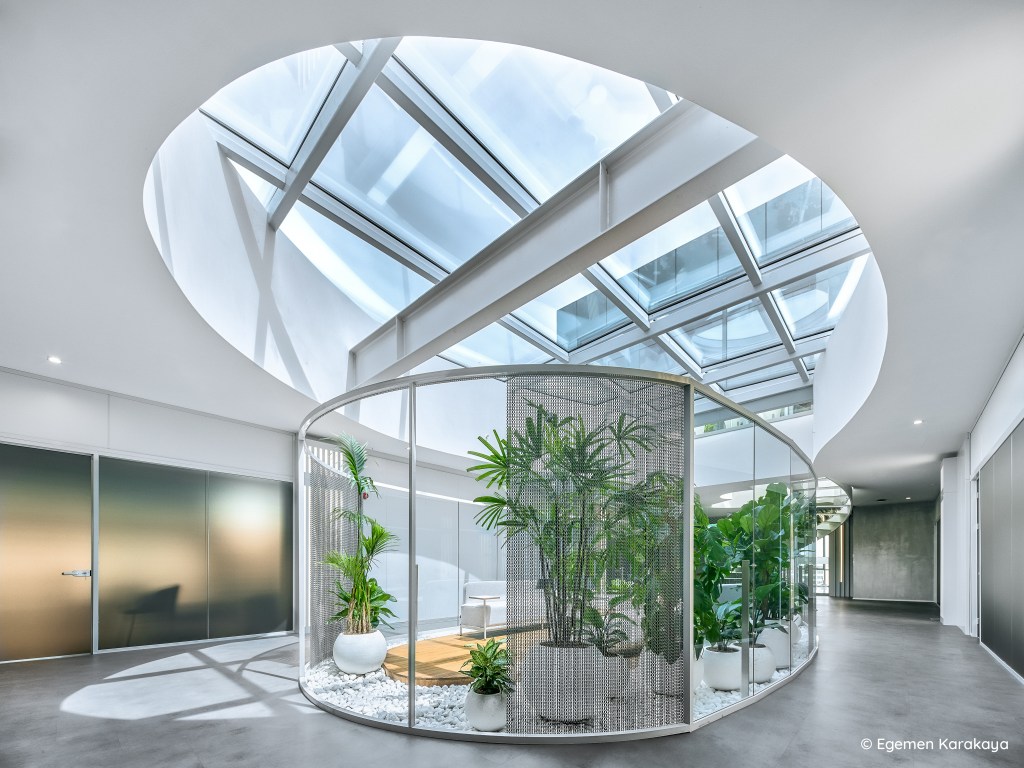
 The building’s entry points were designed to separate access for employees and visitors. There are two main entrances: one on the ground floor for employees and another on the first basement floor for visitors. This separation eased circulation, reduced congestion, and maintained employee privacy while allowing visitors direct access to dedicated areas. Starting from these entrances, a consistent design language was adopted throughout the building. The vertical circulation core played a key role in organizing the interior layout, with circulation corridors positioned centrally on each floor. This arrangement ensured equal access to all workspaces while providing efficient and easy movement.
Natural light is a fundamental principle for creating a good spatial experience One of the main goals of the design was to maximize natural light usage, supporting individual well-being and enhancing energy efficiency. On the typical office floors, workspaces were positioned along the façade to make the most of natural light. On the 12th floor, skylights were added, allowing even the more enclosed executive floor to benefit from natural lighting.
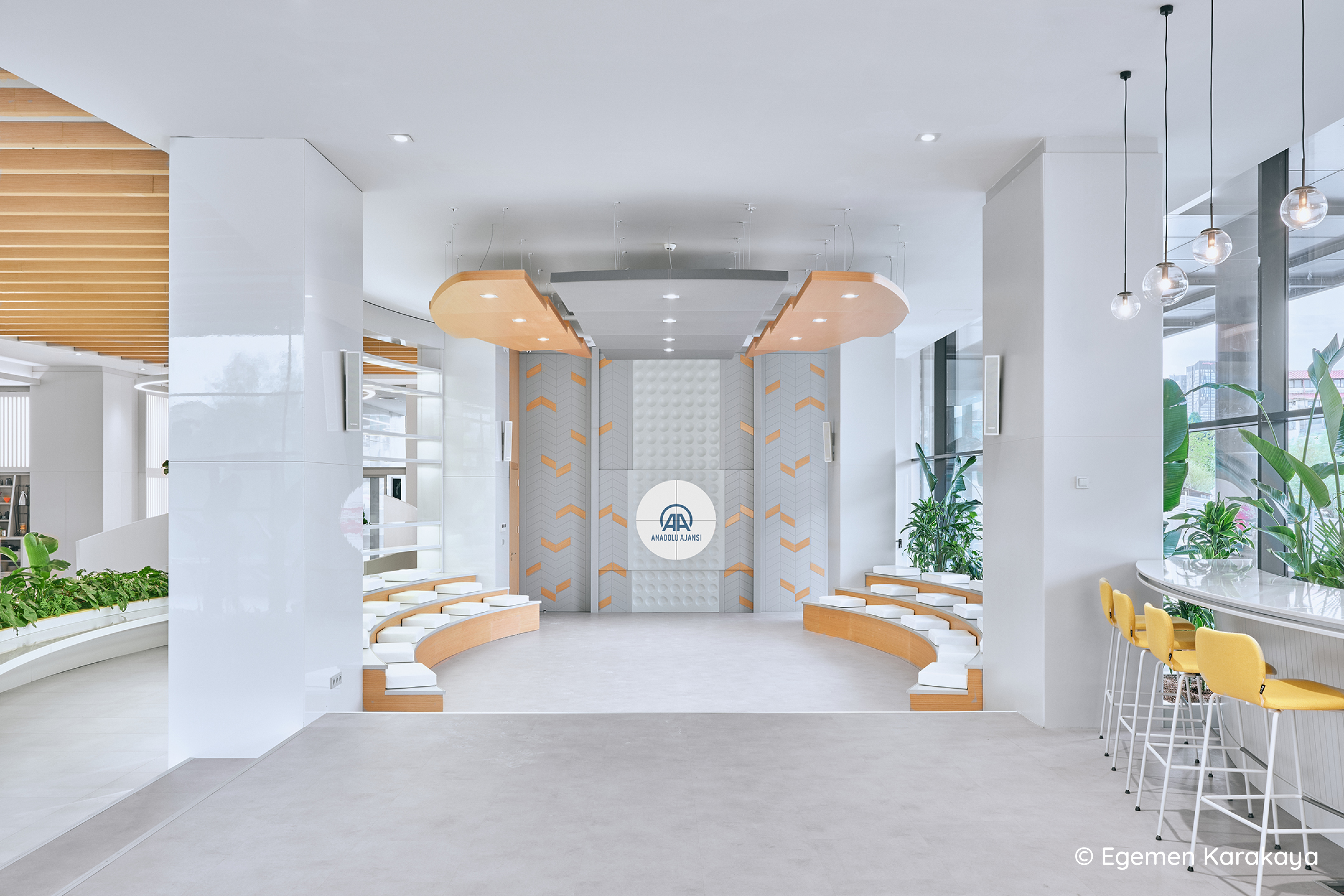

Flexibility was a cornerstone of the design, acknowledging the need for adaptability in dynamic environments. The office floors were designed with the specific requirements of various departments while maintaining the flexibility to adapt to future changes. Instead of solid walls, podiums were used to delineate spaces, offering modularity and ease of infrastructure updates. This podium concept provided a unifying design language throughout the building. Glass partition walls were used in administrative areas to enhance transparency, creating visual connections between spaces. The design also leveraged the building’s panoramic city and forest views, complemented by minimalist and transparent furnishings to create a sense of openness and lightness.
Given the agency’s need for archiving, additional storage was incorporated through mezzanine levels in the first basement, utilizing areas with reduced floor height. On the office floors, multifunctional furniture integrated built-in storage solutions, ensuring efficient use of space.
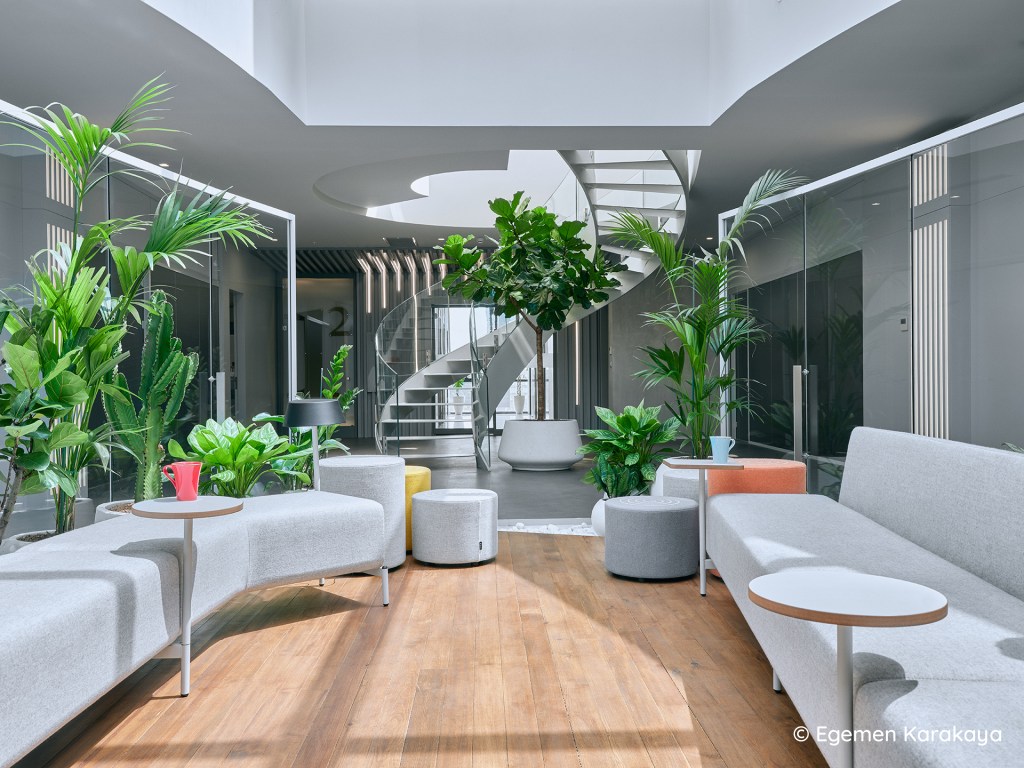
Recreational and communal areas were integral to the project, supporting both social interaction and individual well-being. On the first basement floor, spaces such as a gym, a digital media wall, exhibition areas, and a sound wall for listening to historical recordings foster a sense of community and engagement. The ground floor features a Café-Bistro, Conference Hall, Library, and Exhibition Area, strategically placed to enhance interaction and functionality. On the office floors, seating areas along circulation routes and recreational zones in corner spaces provided opportunities for relaxation and informal collaboration. Small meeting spaces, referred to as “think-tanks,” were included on each floor, alongside acoustic booths for focused individual work. On the executive floor, specialized recreational spaces included a central “Glass Bubble,” offering a comfortable meeting area while guiding circulation. The terrace floor houses a meeting room and a library, offering serene environments for focused discussions and study.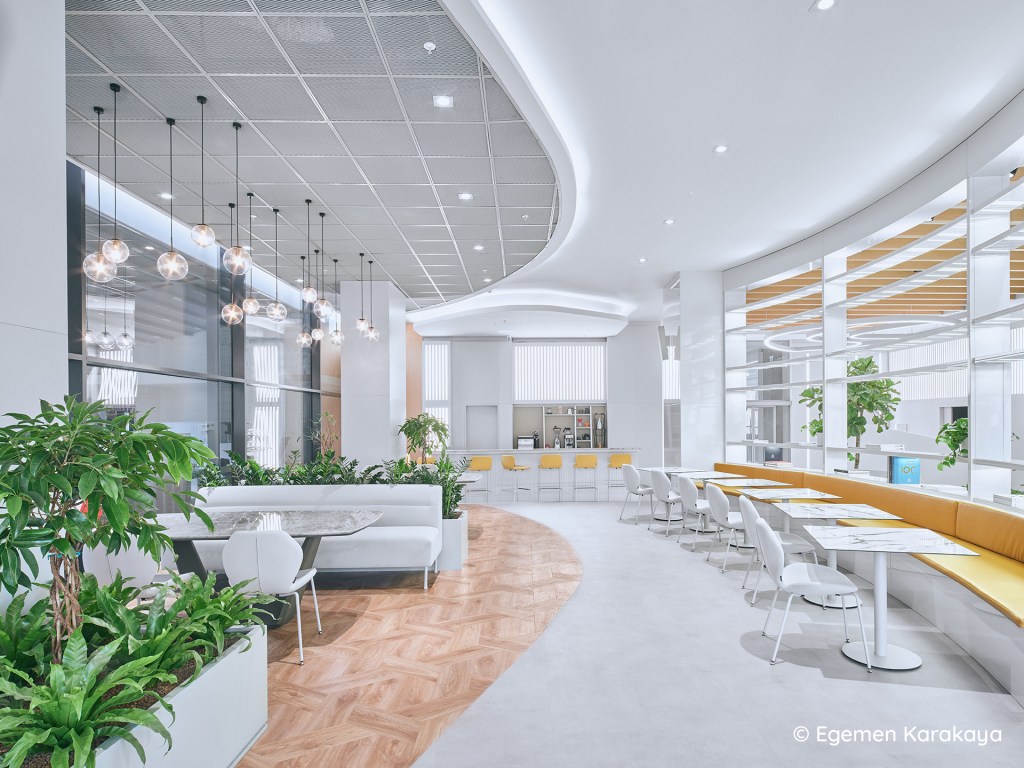
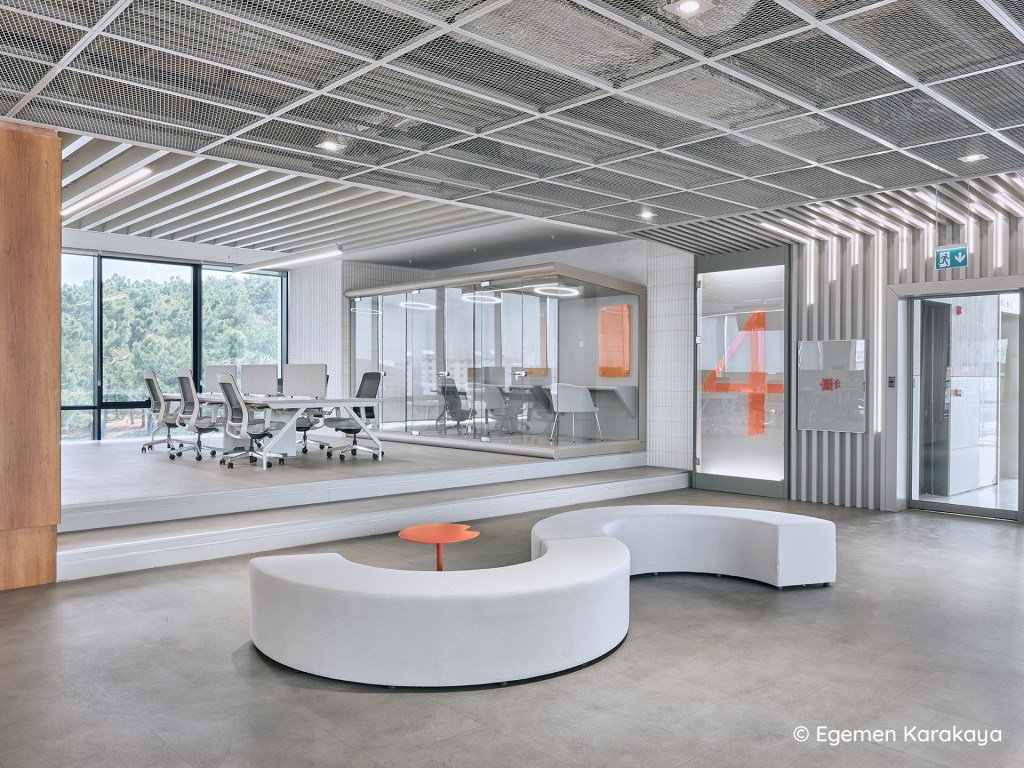
The design carefully balanced organizational hierarchy with equality in spatial access. Spaces were planned to reflect the organization’s structure, ensuring accessibility while maintaining a sense of equity. While all departments followed a consistent spatial layout, differences were highlighted using distinct colors and textures. Unique color schemes were employed on each office floor, ensuring a sense of identity for each level while preserving a cohesive design language.
A comprehensive landscaping project was implemented to harmonize the relationship between interior and exterior spaces. The landscaping not only complemented the building’s design philosophy but also created a calming and natural environment, supporting individual well-being and enhancing the overall user experience. This integration of natural and built elements emphasized the holistic and human-centric approach that defined the project.

 Project Location
Istanbul
Land Area
2.990,00 sqm
Total Construction Area
15.000,00 sqm
Project Start & End Year
2021 – 2023
Employer
Anadolu Agency
Interior Architecture Project and Design Team
İrem Arıbaş, Hüseyin Beş, Yurdaer Beş, Fırat Ceylan, Meltem Rabia Şimşek
Interior Architecture Concept Project Design
BAB Architects
3D Visualization
BAB Architects
Interior Architecture Application Project
BAB Architects
Custom Made Furniture Design & Application
BAB Architects
Interior Landscape Project
Verda Botanic