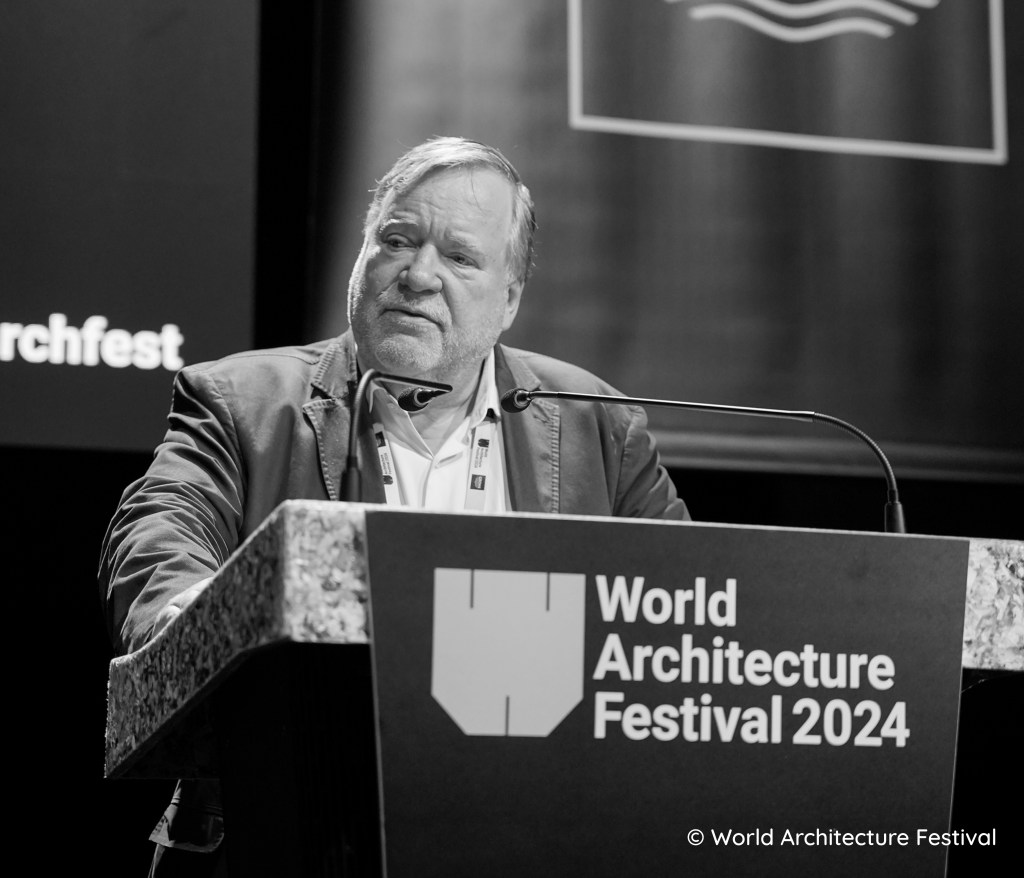
Paul FINCH | Programme Director
development & progress of WAF…
The fundamentals of WAF have not changed very much: first, a major awards covering completed buildings, future projects, interiors and landscape; second, a thematic conference on the main stage; and third a parallel programme on the secondary stage; third, live presentations by shortlisted architects and designers to international juries, with delegates in the presentation rooms to see and hear what is being presented, and what the judges make of it; and fourth a gala awards dinner to conclude the festival.
I think the WAF’s main contribution to architecture is the bringing together of professionals from across the world who can experience what their talented contemporaries and designing, thinking and presenting. It is a friendly event, where the competitive element is about celebration of great work rather than pitching for commissions. For three days, the delegates can remind themselves out why they fell in love with architecture and design in the first place.
innovations of WAF 2025…
We are planning a separate practice management series of sessions in conjunction with the US organization Design Intelligence; in addition, we will launch a 40 under 40 intended to identify the best young talents working in the USA, Canada and Mexico.
WAF 2025 & Miami…
We have wanted to stage the event in the USA for many years and carried out a reconnaissance trip in 2017. Unfortunately, Covid-19 intervened!
Our reasons are simple: any global event such as ours needs periodically to be located in the Americas for geographical balance; there are a huge number of architects and designers in the USA who have not experienced WAF and we would like to attract them, partly for commercial reasons, but more importantly to tap into a wealth of culture and creativity that the North American profession has to offer.
There are numerous American cities we could have chosen, but Miami is attractive because it connects easily to Central and South America, from whose architects we hope to attract new awards entrants and delegates.
the importance of venue…
Partly through numbers of entrants and delegates, and partly through post-event research which leads to something called ‘net promoter scores’, a measure of whether a delegate would recommend the event to a colleague.
planned innovations…
We will continue to have additional elements like special prizes for use of various materials, colour, natural light or visualisations.
These are add-ons rather than substitutes for the core programme.
highlights…
Jury members are interested in seeing presentations which are clear, well-illustrated, and which use the limited presentation time to maximum effect – whatever the particular category or design.
You expect to get coherent accounts covering ‘who, what, where, when, how and why’; there is generally some explanation about the energy/carbon/sustainability strategy for the design.
The judges take notes but are not required to provide scoresheets. We rely on their collective judgement, and so far, this has worked very well.
from the beginning to now…
The first festival in Barcelona in 2008, was very special, because it proved that we could deliver what we had been discussing and planning for two years; another was the award of a Contribution to Architecture, made to Norman Foster in Berlin in 2017.
unusual…
This is the only time that (INSIDE | Health & Fitness) a jury did not pick any form of winner. The circumstances were very unusual: a small entry, and presentations that did not do justice to the promise of the award entry boards. After speaking to a very responsible group of jurors, we agreed with their recommendation.
We don’t anticipate this becoming a common feature of the Festival because although some categories will be stronger than others in any given year, as with the Olympics, even given a slow race, somebody crosses the line first!